
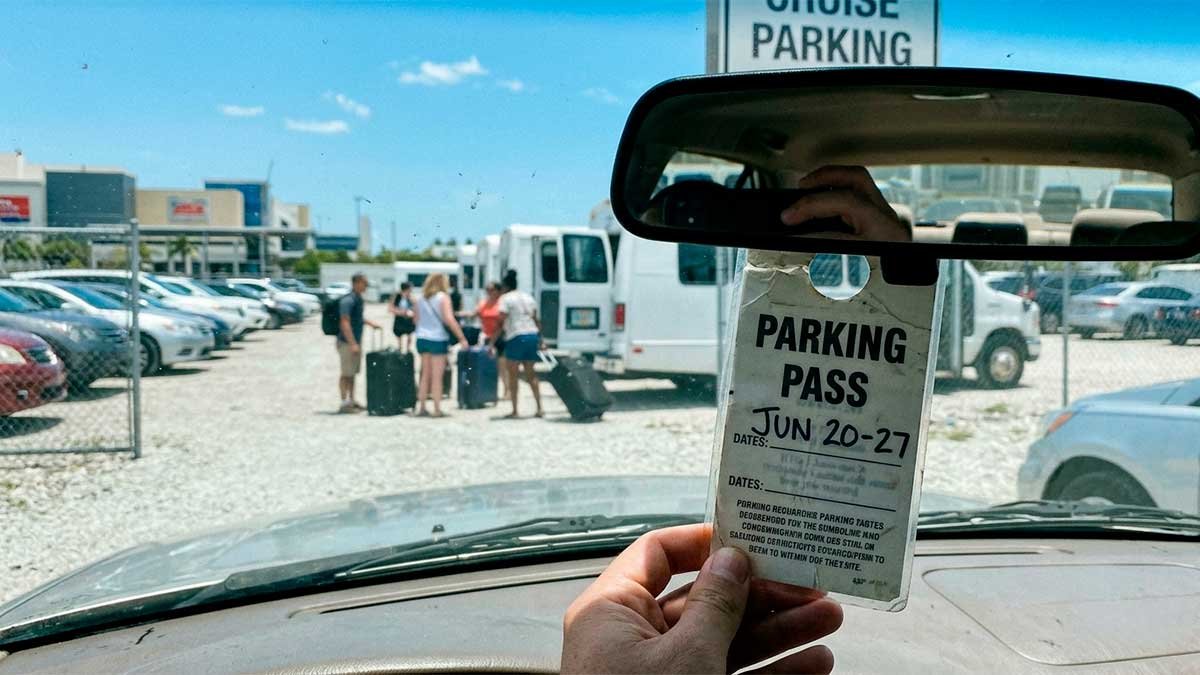
Choosing between official PortMiami parking garages and off-site independent lots comes down to a trade-off between baseline price and logistical predictability. Official on-port parking costs $22 to $28 per night depending on the specific cruise terminal, offering covered vehicle protection, direct pedestrian bridge access to your ship, and zero reliance on third-party shuttle schedules. Conversely, independent off-site lots advertise rates as low as $8 to $12 per day, but these prices frequently exclude mandatory port drop-off fees, luggage surcharges, and per-passenger transit costs calculated at checkout.
Off-site options introduce substantial time variables, often requiring an extra 45 to 90 minutes of travel time due to erratic shuttle frequencies, bridge openings on the Miami River, and heavy traffic along Biscayne Boulevard or the Port Boulevard tunnel. If you value tight scheduling and vehicle security, the official garages neutralize transit risks, whereas off-site lots require a strict buffer window to avoid missing your embarkation time.
PortMiami’s official garages charge $20 to $35 a night depending on which terminal your cruise line uses, and the rate isn’t something you get to choose. Independent lots a few miles inland advertise as low as $8 a night with a shuttle included. On paper, a seven-night cruise costs up to $245 at the terminal versus $56 off-site — a gap that looks too obvious to argue with. It isn’t.
The real comparison involves two billed days you didn’t plan for, a shuttle that may or may not show up when your ship docks early, and at least one documented case of a Miami parking operator losing track of whose keys belonged to which car. This is the math, the actual risk, and the loophole that beats both options for the right traveler.
The Terminal Garage Premium: What You’re Really Paying For
PortMiami runs parking garages and surface lots across its active cruise terminals, and the rate you pay tracks your cruise line, not your preference. According to the port’s own parking page, standard long-term rates run $20 to $25 per vehicle per day depending on the garage, while Garage A — used by Norwegian Cruise Line — moved to $35 per vehicle, per day effective January 1, 2025. Oversized vehicles, RVs, and anything towing a trailer get routed to Lot 2 across from Terminal E, where the surcharge adds another $25 on top of the standard rate.
What that premium buys is straightforward: a structure within walking distance of check-in, security patrols, and a complimentary shuttle reserved for embarkation mornings. It does not buy a guaranteed spot. Parking at the official garages runs first-come, first-served, with no reservation system at most terminals — which means a Saturday morning during peak season can mean circling a garage that’s already full while your check-in window ticks away.
One detail trips up more drivers than the price tag: garage assignment follows your cruise line, not your terminal preference, and assignments can shift between when you book your cruise and when you actually sail. Park at the wrong garage because your confirmation listed an outdated terminal, and you’re walking to a different building with luggage, or paying for a second ride to cover the gap. Terminal J adds its own wrinkle — it’s the only garage at PortMiami where parking is paid on arrival rather than on exit, with a decal issued for your windshield instead of a ticket you settle on the way out. And one more thing worth checking before you drive in at all: the port’s garages don’t accept debit cards, only cash and major credit cards, which is the kind of detail that turns a routine drop-off into a scramble if you weren’t expecting it.
The Off-Site Math Nobody Runs All the Way Through
Independent lots near Downtown Miami post rates of $8 to $15 a night, undercutting the official garages by more than half. The advertised number is real. The total you actually pay tends to run higher than the comparison table implies, for three reasons that rarely make it into one.
You’re billed for both travel days, not just the nights in between. Most off-site operators charge for any portion of a calendar day, the same way the port garages do. Arrive Saturday afternoon for a seven-night cruise, return the following Saturday morning, and you’re billed for eight days, not seven. At roughly $12 a night, that turns an expected $84 into closer to $108 once taxes and fees land on top — a gap that’s easy to miss if you’re comparing headline rates instead of total checkout price.
The shuttle is the part of the deal you can’t price in advance. Reviews of these operators describe two very different experiences sitting side by side: one traveler reporting a smooth pickup with a van ready on arrival, and another describing a wait of well over an hour for the return shuttle after disembarking — long enough that they gave up and paid for a taxi instead, with a pointed warning that anyone counting a saved cab fare as part of their total savings shouldn’t. If your contingency plan involves an Uber back to retrieve your car, price that fare into the comparison before deciding off-site is cheaper. Often it isn’t, once you do.
Some of these spaces aren’t fully the operator’s to sell. This is the detail almost no parking guide mentions, likely because most of those guides are funded by the operators they’re reviewing. A documented pattern in Miami’s airport and cruise parking market involves operators securing blocks of spaces in garages or lots around the city and reselling them to passengers — arrangements that periodically fall apart, after which customers calling for their pre-booked shuttle get redirected to a different lot entirely. One review describes exactly this: directions to one address, a redirect on arrival to a second address blocks away, and chaos on arrival at the second lot, with no staff at the ticket machine and dozens of other passengers already waiting for transport that hadn’t shown up yet.
So Which One Actually Wins?
If your cruise runs three to five nights, the port garage’s premium over off-site buys back enough certainty — no shuttle dependency, no risk of a redirected lot — that it’s worth paying. If your cruise runs seven nights or longer, an off-site lot can still win on price even after the two-day billing quirk, but only if you book a provider with verifiable recent reviews and confirm in writing what address your shuttle actually picks up from. Skip any lot you can’t find recent, dated reviews for, no matter what rate it advertises.
When the Key Isn’t Yours Anymore
The detail that separates a good parking decision from a bad one isn’t the rate. It’s whether you keep your keys.
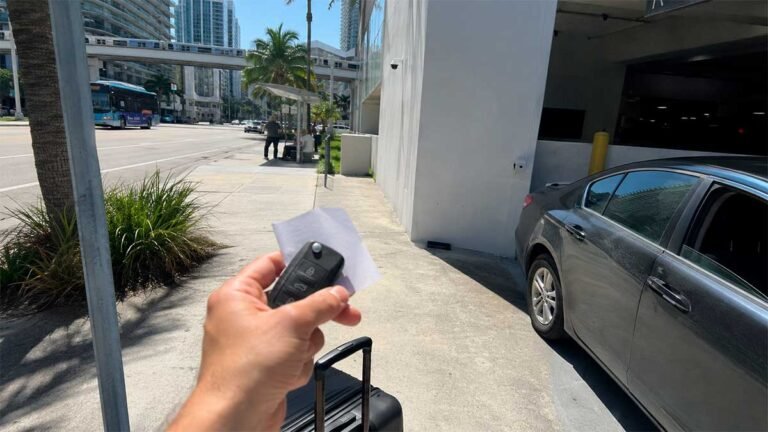
Self-park facilities let you walk to your own car and drive away on your own schedule. Valet-style lots — common among the cheapest off-site options — take your keys at drop-off and move your car into position themselves, which means someone you’ve never met has access to your vehicle for the full length of your cruise. Most of the time this is uneventful. Miami’s CBS affiliate documented a case where it wasn’t: dozens of cruise passengers returned to a lot operated by a Tampa-based company to find their keys missing entirely, with the company suspecting a disgruntled or fired employee had walked off with a batch of them. Miami police confirmed officers had been called to that same lot eight times in a matter of days, for incidents ranging from burglary to a hit-and-run with the driver fleeing the scene.
That’s a worst case, not a typical one — but a milder version of the same underlying problem shows up constantly in reviews of valet-style cruise lots: a returning passenger waiting over 90 minutes to get their car back because staff couldn’t locate it, then discovering it was blocked in by another vehicle whose keys nobody could find, with police eventually called in just to get the car released.
If you’re storing a car for a week or longer at a lot you’ve never used before, ask one question before you book: do I keep my keys, or do you? If the answer is “we keep them,” that’s not automatically a dealbreaker — most valet operators run for years without incident — but it’s the single question that determines whether your return is a five-minute walk to your own car or an hour standing around while someone tries to find it.
The Park-and-Cruise Hotel Loophole
There’s a third option that beats both of the above for a specific kind of traveler, and it rarely shows up in standard comparisons because it isn’t really a parking decision — it’s a where-to-stay decision with parking attached.
A handful of hotels within a few miles of PortMiami — concentrated in Downtown and Brickell — sell a park-and-cruise package: one night’s stay, plus free or steeply discounted parking for the full length of your cruise, plus a shuttle to the terminal on embarkation morning. Properties like the Hilton Miami Downtown and the Hampton Inn & Suites Miami/Brickell-Downtown both run versions of this, typically priced at $25 to $30 over the hotel’s standard room rate — which works out to effectively free parking once you account for what a week at the port garage would have cost on its own. It’s worth confirming current package pricing directly with the hotel before you book, since these rates shift with season and occupancy.
The math only works in one direction, though. If you weren’t already planning to spend a night in Miami before boarding, booking a hotel room purely to access its parking deal rarely beats simply paying the port garage directly — you’re trading a parking fee for a room rate, and the room rate is usually the bigger number. Where this loophole earns its name is for travelers who were already planning to fly in a day early to avoid a tight embarkation-morning connection. For that traveler, the math stacks two ways at once: the hotel parking package replaces what would have been a $175-to-$245 port garage bill, and the night in Brickell or Downtown removes the shuttle-dependency risk that defines every off-site lot. You sleep three miles from the terminal, walk to your own car the next morning, and drive yourself in — no valet, no redirect, no shuttle window to gamble on.
The trade-off is timing flexibility. Most park-and-cruise rates are built around a single night immediately before departure, not a flexible window, and availability tightens fast during the November-through-April peak season — the same stretch when PortMiami sees its heaviest passenger volume of the year. Book this further out than you’d book a standard hotel night, and confirm the parking duration covers your full sailing length before you pay.
Matching the Move to Your Sailing
A three-night Bahamas run doesn’t carry the same math as a ten-night repositioning cruise, and the right call changes with it.
| Trip Profile | Best Move | Why |
|---|---|---|
| 3–5 night cruise, no pre-cruise stay planned | Port garage | Premium buys certainty; off-site savings are too small to offset shuttle risk |
| 7+ night cruise, no pre-cruise stay planned | Vetted off-site lot, self-park only | Savings clear the two-day billing quirk; keeping your own keys removes the main risk |
| Any cruise length, already flying in a day early | Park-and-cruise hotel package | Replaces the garage bill entirely; removes shuttle dependency |
| Sailing from Terminal J or a luxury line | Port garage, budget for pay-on-arrival | Confirm payment method before driving in — it’s the one terminal that doesn’t bill on exit |
If you’re flying into Miami the morning of your cruise rather than driving your own car, the parking decision doesn’t apply to you at all — what matters instead is whether your MIA-to-PortMiami transfer leaves enough buffer for South Florida traffic, which is a different logistics problem with its own failure points entirely.
Frequently Asked Questions
Does PortMiami parking require a reservation?
Most terminals run first-come, first-served, with no way to guarantee a spot in advance through the port itself. Check your cruise line’s own booking portal before you sail, since some now offer advance parking reservations separately from the port’s general system.
Is it safe to leave a car at an independent lot for a full week?
Most of the time, yes — these lots operate for years without incident. The exposure comes specifically from valet-style lots where staff hold your keys rather than you keeping them, since that’s the scenario behind both the documented mass key loss case above and the more common “we can’t find your car” delays reported in reviews. Self-park facilities remove most of that risk.
Why do off-site lots charge for more days than I actually parked?
Most operators, on-site and off-site alike, bill for any portion of a calendar day. Arriving Saturday afternoon and returning the following Saturday morning means eight billed days for a seven-night cruise, not seven — factor that into any advertised per-night rate before comparing it to the port.
Is a park-and-cruise hotel actually cheaper than just paying the port garage?
Only if you were already planning to spend a night in Miami before boarding. If parking is the only reason you’d book the room, the room rate usually outweighs what you’d save — this works for travelers already arriving a day early, not as a parking strategy on its own.
For current official rates and accepted payment methods by garage, PortMiami’s parking information page is the most reliable source to check before you drive in, since terminal assignments and rates do shift.