
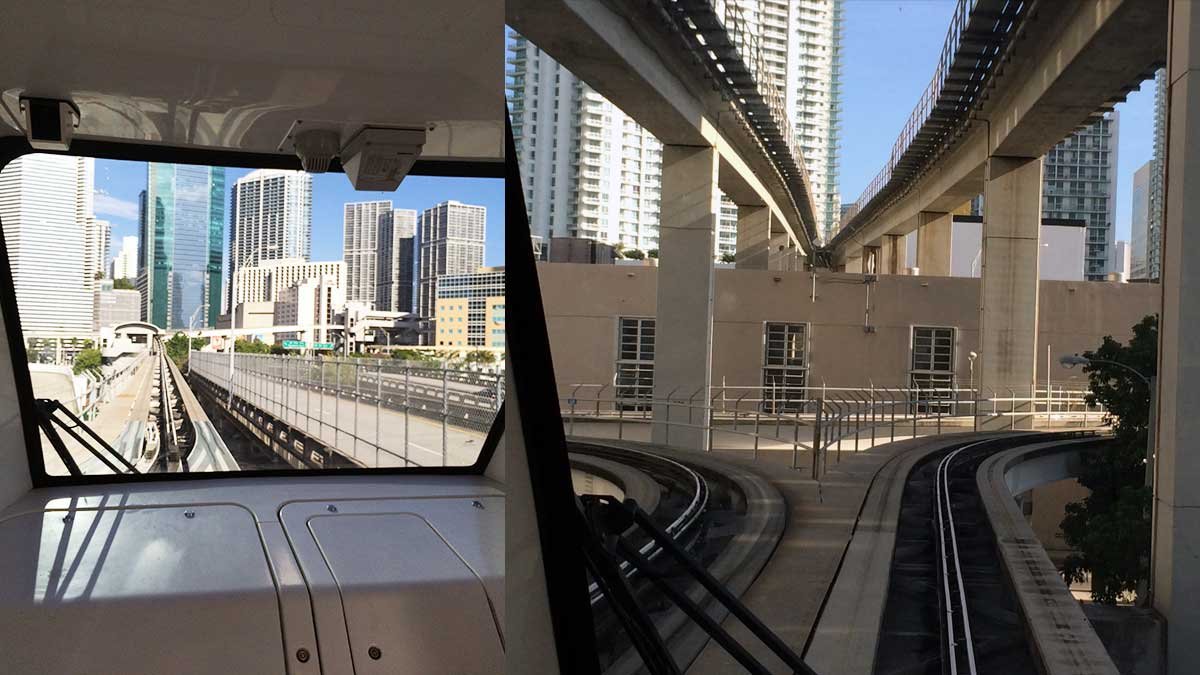
Driving a vehicle through the urban core of Miami during business hours or major events is a fast way to ruin your day and empty your wallet. The city looks accessible on a map, but street-level reality involves massive traffic bottlenecks, unpredictable drawbridges that halt entire avenues for passing yachts, and a predatory parking ecosystem where leaving your car for two hours can easily equal the cost of a high-end dinner. Fortunately, a massive infrastructure hack sits right above the gridlock, running on its own elevated concrete tracks, and it does not cost a single cent to use.
The Miami Metromover is a fully automated, driverless electricity-powered rail system that loops continuously through Downtown Miami, the financial district of Brickell, and the northern cultural hub of the Omni neighborhood. While unsuspecting visitors sit trapped in Ubers watching the meter tick upward during a tropical downpour or a Miami Heat game, smart commuters use this overhead system to skip the gridlock entirely. This guide breaks down the operational mechanics, street-level connection strategies, and real-world scenarios you need to navigate these loops like someone who actually lives here.
The Zero-Dollar Reality Check: No Tickets, No Cards, No Gatekeepers
The hardest thing for first-time visitors to accept about this transit system is that it requires absolutely nothing from you to ride. Most travelers arrive at a station expecting to find a ticket kiosk, a card scanner, or at least a turnstile where they can tap a smartphone or credit card.
Direct Answer for Travelers: The Miami Metromover is entirely free for every passenger, with zero ticketing infrastructure. There are no turnstiles, fare gates, or card readers at any of the 21 stations across the system. You walk up the stairs, ride the escalator, or take the elevator straight onto the open platform, wait for the automated doors to slide open, and step onto the train.
This complete lack of physical checkpoints causes genuine hesitation. Tourists often stand around the platform entrances looking for a place to pay, convinced they will face a heavy fine for fare evasion. You can drop that anxiety immediately. The entire network is funded through a dedicated local sales tax initiative passed by the county, meaning your rides are completely prepaid by local commerce. You only need to touch a wallet or buy an EASY Card if you intend to leave the Metromover network and transfer to the heavy-rail Metrorail lines or the county Metrobus system. If your itinerary stays within the borders of Brickell and Downtown, you can navigate the city without spending a dime on transportation.
The Brickell Bridge Bottleneck and the Mechanics of Miami Gridlock
To understand why the Metromover is an essential tool rather than just a budget alternative, you need to look at how Miami’s geography breaks down at street level. Downtown Miami and Brickell are separated by the Miami River. Only a few arteries connect these two high-density zones, and the primary path is the Brickell Avenue Bridge.
This bridge is a bascule drawbridge. Throughout the day, on a regular schedule and during unexpected marine emergencies, the bridge splits in half and rises into the air to let cargo ships, commercial vessels, and luxury mega-yachts pass through. When this happens, street traffic on both sides of the river instantly paralyzes. A line of cars backs up deep into the financial district along Brickell Avenue and spills onto SE 2nd Avenue, choking every intersecting street for blocks.
If you are inside an Uber or riding in a rental car during a bridge opening at 5:30 PM, you are trapped. Rideshare apps will trigger surge pricing because the trip duration suddenly triples, turning a projected $9 ride into a $32 expense for moving less than a mile.
The Metromover bypasses this entire geographic choke point. The system crosses the Miami River on a fixed, high-clearance concrete rail bridge built far inland and high above the water line. The automated trains pass over the river continuously, completely unaffected by boat traffic, bridge openings, or ground-level gridlock. A trip from the heart of the financial center to the Downtown shopping districts takes less than ten minutes on the rail, compared to an unpredictable 30-to-45-minute crawl on the asphalt below.
Decoding the Three Loops: Destination-First Navigation
The official maps posted inside the stations look like an unreadable maze of overlapping colored lines. The county names the routes the Inner Loop, the Brickell Loop, and the Omni Loop. Instead of trying to memorize track geometries or confusing street coordinates, you should navigate based on where you actually want to go.
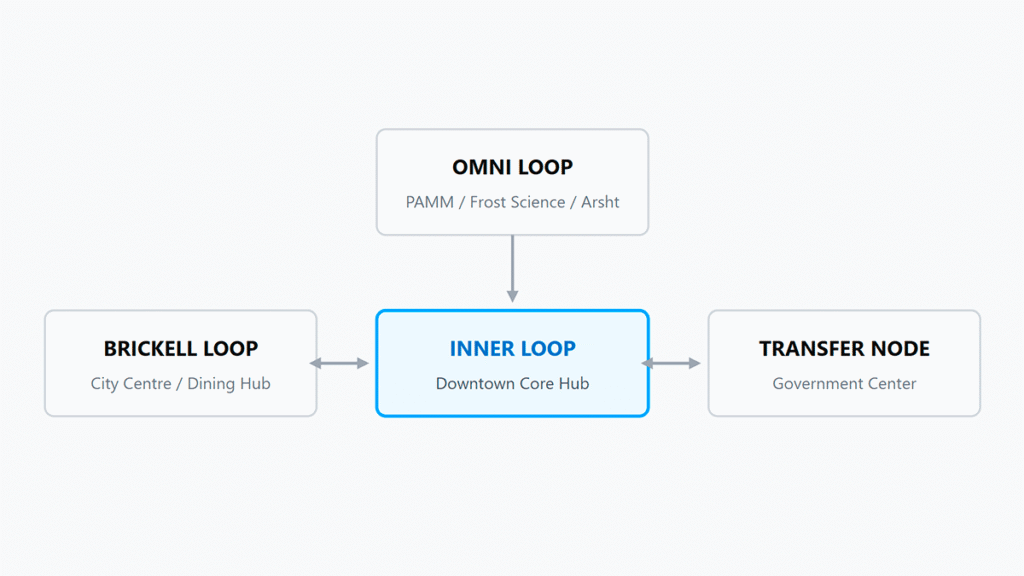
The Inner Loop (The Downtown Core Hub)
This loop operates in a tight, continuous circle around the historic center of Downtown Miami. It functions as the central gear of the entire system, moving clockwise through the highest concentration of historic office blocks and government buildings.
- Key Stations: College/Bayside, First Street, Government Center.
- Where It Takes You: Use this loop if you are heading to Bayside Marketplace for waterfront dining, catching a concert or a basketball game at the Kaseya Center, or accessing the federal courthouse complex.
- Transfer Logic: This is the only loop that does not cross the river into Brickell or head north to the museums. It stays strictly in the center. Every station on this loop allows you to step off your car and wait on the same platform to catch a train heading out to the other two legs of the city.
The Brickell Loop (The Financial, Shopping & Dining District)
This route branches off the central core, heads south over the Miami River, and runs a counter-clockwise loop through the dense financial district before heading back Downtown.
- Key Stations: Brickell City Centre, Tenth Street Promenade, Financial District.
- Where It Takes You: This is the most heavily used route for lifestyle travel. The Brickell City Centre station drops you literally inside the multi-level luxury shopping mall, completely protected from external weather. The Tenth Street Promenade and Financial District stations place you within a two-block walk of the city’s highest concentration of upscale steakhouses, rooftop lounges, and high-end hotel properties along Brickell Avenue.
- Transfer Logic: When riding from Brickell back toward Downtown, the train will merge into the Inner Loop tracks. If you want to continue all the way north to the museums on the Omni Loop, you should exit at Government Center or College/Bayside and step onto an Omni-bound train.
The Omni Loop (The Arts, Culture & Waterfront Parks Route)
This leg leaves the Downtown core and heads directly north into the arts and entertainment districts, running counter-clockwise along the Biscayne Boulevard corridor.
- Key Stations: Museum Park, Adrienne Arsht Center, School Board.
- Where It Takes You: This is your dedicated cultural line. The Museum Park station places you directly on the green plazas separating the Pérez Art Museum Miami (PAMM) and the Phillip and Patricia Frost Museum of Science. The Arsht Center station leaves you at the doorstep of the city’s primary opera and theater house.
- Transfer Logic: If you are staying at a hotel in Brickell and want to spend the afternoon at the Frost Science Museum, you will take the Brickell Loop north, ride it across the river, hop off at College/Bayside station, and wait on that exact same platform for the train clearly marked “Omni Loop.”
The Visual Cheat Code: Architecture and the Front Window Trick
Most Miami public transportation systems are something you tolerate just to get from point A to point B. The Metromover is different; for anyone visiting Miami for the first time, it operates as a free, elevated architectural tour that rivals paid sightseeing operations.
Because the entire network runs on driverless, automated technology, there is no operator cabin or partition wall at either end of the train cars. The front and rear of the vehicles are massive, unobstructed glass windows. If you board a train and stand directly against the front glass, you are treated to a dramatic, changing perspective of the skyline that is completely hidden from the street level.
The tracks do not run down the middle of wide open avenues; they weave tightly between the skyscrapers, often clearing the glass facades of corporate headquarters and luxury condo towers by only a few feet.
Dramatic Vantage Points to Look For:
- The Knight Center Pass-Through: In the miolo of Downtown, near the Knight Center and Miami Avenue stations, the concrete tracks perform an engineering feat by slicing directly through the interior structural footprint of the buildings. You are riding an open rail line that passes through tunnels built inside towering office complexes, giving you a brief glimpse into the interior lobbies and mezzanine levels from mid-air.
- The Northern Skyline Sweep: As the Omni Loop train heads north toward Museum Park, the track curves sharply over the highway connectors. For a few moments, the view opens up completely to the east, revealing a panoramic sweep of Biscayne Bay, the cruise ship terminals at PortMiami, and the expansive MacArthur Causeway stretching toward South Beach.
The Reality of Miami Weather: Walking vs. Overhead Comfort
Distances in the urban core are highly deceptive to tourists looking at a digital map. A walk from a hotel on the southern edge of Brickell to the museums at Museum Park appears to be a reasonable urban hike of roughly two miles (3.2 km).
However, trying to complete that walk between the months of June and September means exposing yourself to the real climate profile of South Florida. Temperatures routinely hover around 95°F (35°C) with humidity levels that make the air feel thick and heavy. The streets are wide, shade from the buildings disappears entirely at midday, and the concrete sidewalks radiate intense heat upward. Furthermore, summer afternoons in Miami are notorious for sudden, violent tropical downpours that saturate the streets in a matter of minutes.
The Metromover changes how you manage your physical energy during a trip. The stations are elevated, catching the breeze from the bay, and the train cars are equipped with heavy-duty, industrial air conditioning units that keep the interior cabins ice-cold even when the outdoor heat index is broken.
Consider this direct breakdown of common routes through the center of the city:
| Route Corridor | Street-Level Walk (Real Experience) | Metromover Transit Route |
| Financial District to Bayside Marketplace | 35 minutes / Heavy sun exposure, crossing the high-traffic river bridge on foot. | 12 minutes / Fully air-conditioned ride on the Brickell Loop directly to the park edge. |
| Government Center to Kaseya Center | 18 minutes / Navigating uneven sidewalks, multiple wide traffic light cycles. | 5 minutes / Direct hop on the Inner Loop, dropping you right at the arena entrance. |
| Brickell City Centre to Frost Science Museum | 50 minutes / Unrealistic for families or business travelers; guaranteed heat exhaustion. | 16 minutes / Brickell Loop with a seamless same-platform transfer to the Omni line. |
Real-World Cost Simulation: The Tourist Trap vs. The MTH Move
To illustrate the financial impact of understanding local transit infrastructure, let us look at a typical day-long itinerary through Miami’s urban center. In this simulation, a family of three is staying at a hotel in the Brickell financial district and wants to spend the day shopping at Brickell City Centre, eating lunch at Bayside Marketplace, visiting the Frost Science Museum in the afternoon, and heading out for dinner on Brickell Avenue.
Scenario A: The Uninformed Tourist (Rideshare & Car Dependency)
- Morning Mall Trip: The family takes an Uber from their hotel down the street to Brickell City Centre because it is raining. (Short trip surge: $14.00)
- Lunch Logistics: They hail another rideshare from the mall to Bayside Marketplace during the noon lunch rush. The car sits on the SE 2nd Avenue bridge for twenty minutes. ($19.50)
- Afternoon Culture: They take an Uber from Bayside north to the Frost Science Museum. ($12.00)
- Return for Dinner: They head back to the hotel to change before dinner. It is now 5:15 PM, peak afternoon rush hour. The app triggers heavy surge pricing due to the gridlock on Biscayne Boulevard. ($31.00)
- Evening Dinner Out: They decide to drive their rental car to the steakhouse on Brickell Avenue to avoid another Uber fee. They are forced to use the restaurant’s mandatory valet service. ($35.00 flat rate + $5.00 valet tip)
- Scenario A Financial Total: $116.50 spent on basic intra-neighborhood transit.
Scenario B: The Smart Move (The Miami The Hype Playbook)
- Morning Mall Trip: The family walks one block to the nearest covered Metromover station and takes the Brickell Loop train directly into the third level of Brickell City Centre, staying completely dry. ($0.00)
- Lunch Logistics: They board the next train at the mall station, cross high over the river, transfer at College/Bayside, and step off at the entrance of Bayside Marketplace. ($0.00)
- Afternoon Culture: They catch the Omni Loop train from the same platform and ride it two stops north to the Museum Park station, stepping off onto the museum plaza. ($0.00)
- Return for Dinner: They take the Omni Loop back into the central hub and switch to a Brickell-bound train, gliding smoothly over the gridlocked rush-hour traffic on the bridge below, arriving back at their hotel fresh and cool. ($0.00)
- Evening Dinner Out: They use the Metromover to ride down to the Tenth Street Promenade station, placing them a brief walk away from the restaurant row, leaving their rental car untouched in the hotel garage. ($0.00)
- Scenario B Financial Total: $0.00 spent on transportation.
By utilizing the overhead rail system, the family in Scenario B saved over $115 in a single day, entirely avoided the psychological frustration of sitting in dead-stop traffic, and never had to deal with the stress of Miami parking operations.
The Airport and Regional Rail Integration Matrix
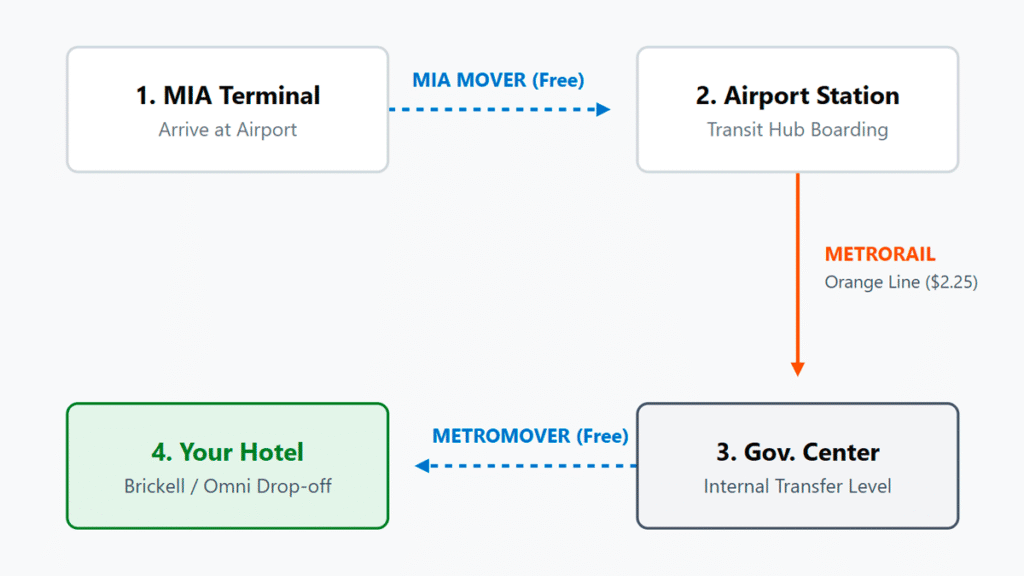
If you want to pull off a sophisticated, low-cost arrival into the city without paying the premium rates demanded by airport car rental counters or rideshare pickup zones, you can use the Metromover as the final link in a highly efficient transit chain.
Moving from Miami International Airport (MIA) to Your Hotel
When you land at MIA, skip the baggage-claim rideshare congestion lines entirely. Follow the overhead airport signs to the MIA Mover, which is a free automated shuttle that carries passengers from the main terminal complex to the Miami Central Station (the city’s primary ground transportation hub).
Once inside the Central Station, look for the Metrorail entrance. You will purchase a single transit ticket or tap your contactless credit card at the gate to pay a flat fare of $2.25. Board the Orange Line train heading south toward Downtown.
You will ride this heavy rail line for approximately 15 minutes, bypassing the notorious traffic on the Dolphin Expressway (SR 836). Exit the Metrorail car at the Government Center Station.
This is where the magic happens. Do not exit the station gates to the street. Instead, look for the internal pedestrian signs directing you up the escalators to the upper levels of the Government Center complex. You will walk straight onto the covered Metromover platforms.
Check the electronic overhead signs, board the train designated for the loop matching your destination (Brickell Loop if your hotel is south of the river, or Omni Loop if you are staying near the arts district), and ride the rest of the way to your destination completely free.
Connecting to the Brightline and Tri-Rail Systems
For travelers arriving via the Brightline high-speed rail network from Orlando, West Palm Beach, or Fort Lauderdale, the train terminates at the massive MiamiCentral station complex in Downtown.
Instead of exiting out onto the hectic streets to search for a taxi or hail a rideshare vehicle, stay entirely inside the station structure. Walk directly toward the eastern side of the complex to access the connected Wilkie D. Ferguson Metromover Station (serviced by the Omni Loop) or follow the interior pedestrian bridges directly into the main Government Center transit hub. From here, you can slip onto a free train and be checking into your Brickell hotel room within ten minutes of stepping off your high-speed rail car.
The same layout applies if you are utilizing the Tri-Rail commuter train system to travel down from Broward or Palm Beach counties. The Tri-Rail Downtown Miami Link brings commuters straight into the MiamiCentral station, placing you immediately adjacent to the free Metromover network.
Nightlife Dynamics, Club Culture, and the Midnight Hard Stop
When the sun goes down, the operational dynamic of the Metromover shifts from a business commuter network into a highly functional transit tool for exploring Miami’s nightlife districts. However, relying on the system for late-night transportation requires a strict understanding of its scheduling limitations.
The Bar-Hopping Strategy
If your evening plans involve hopping between different entertainment zones, you can use the loops to avoid paying double or triple rideshare fees during prime party hours (8:00 PM to 11:00 PM).
You can start your night by exploring the high-density concentration of upscale lounges, mezcal bars, and outdoor cocktail spaces clustered around Mary Brickell Village and SE 10th Street. The Tenth Street Promenade Station sits right in the center of this zone.
When you are ready to transition to the electronic music venues, live performance spaces, or major club concepts located across the river in Downtown’s Park West neighborhood, avoid the temptation to look for a vehicle on the street. Head up to the track platform and take the Metromover north.
Exiting the train at the Eleventh Street Station puts you on the edge of the nightlife corridor, leaving you a short, well-lit walk from the entrance lines of world-renowned 24-hour nightlife venues like Club Space and E11EVEN. By taking the rail, you avoid the extreme gridlock that occurs outside these venues as delivery trucks, partygoers, and luxury cars fight for space on the narrow streets.
The Hybrid Commute Hack for Wynwood and Edgewater
The Metromover tracks do not extend north into popular creative and dining districts like Wynwood, Midtown, or the Design District. If you try to take an Uber straight from the middle of Brickell out to a gallery or brewery in Wynwood at 7:00 PM, your vehicle will spend most of its time stuck on the river bridge or crawling through the Downtown core intersections.
You can outsmart this congestion by executing a hybrid commute. Board the Metromover Omni Loop from any central station and ride it all the way to its northernmost terminal point: the School Board Station.
When you exit the train at School Board Station, you have successfully cleared the entire historical bottleneck of the city center using free electricity. Step down to the street level and open your rideshare app here.
Because you are now sitting right on the border of Midtown and Wynwood, away from the core gridlock, an Uber or Lyft to the heart of the Wynwood art district will typically cost less than $8 and take fewer than five minutes. You have essentially sliced your transit cost and travel time in half by combining public rail with private rideshares.
The Midnight Hard Stop
This is the single most critical warning for anyone planning a night out on the town: The Miami Metromover shuts down completely at 12:00 AM (midnight) every single night.
The system does not extend its hours on Fridays or Saturdays to accommodate club crowds. Promptly at midnight, the power to the tracks cuts out, the automated train cars return to their maintenance facilities, and the station access stairs and elevators are closed up.
If you are inside a venue dancing or having dinner past midnight, you cannot use the rail system to get back to your lodging. Your outbound journey can be executed perfectly for zero dollars, but your return trip at 2:00 AM or 4:00 AM will have to be handled by a street taxi or a rideshare app. Always budget for a one-way surge price ride home if you intend to stay out past the midnight hard stop.
Safety, Comfort, and Street-Level Truths After Dark
A truly useful guide cannot treat public infrastructure like a sanitized holiday resort advertisement. To use the Metromover safely and comfortably, you need an honest assessment of what to expect from the environment at different hours of the day.
During standard daytime operating hours—from 7:00 AM until roughly 7:00 PM—the Metromover is clean, highly secure, and packed with local professionals. You will be riding alongside banking executives traveling between corporate offices, tech workers heading to coffee meetings, federal court employees, and international tourists moving between shopping centers. The environment feels energetic, professional, and entirely safe.
After 9:00 PM, however, the commercial and administrative density of Downtown Miami drops off significantly. The office buildings empty out, retail shops close, and the street-level foot traffic dries up, leaving certain areas of the historic core feeling quiet and sparse.
As a result, you will notice a visible shift in the population using the covered transit spaces. The stations in the historic center of Downtown (particularly around Government Center, Miami Avenue, and Third Street) often become evening rest areas for members of Miami’s unhoused community seeking shelter from the elements.
Smart Safety Rules for Night Riders:
- Pick the Right Cab: The Metromover trains usually run as two-car setups. If you are riding late at night and feel uncomfortable on a deserted platform, look for the car that has other passengers inside and step into that specific cabin.
- Track Security: The county maintains a network of closed-circuit security cameras at every platform, and mobile transit enforcement officers move along the lines frequently. While violent crime on the elevated loops is statistically rare, the main issue late at night is situational discomfort rather than direct physical danger.
- The Brickell Exception: It is worth noting that this late-night atmosphere shift is largely confined to the older Downtown stations. The stations located along the Brickell Loop (such as Brickell City Centre and Financial District) remain highly active, well-lit, and heavily populated by restaurant patrons and residential foot traffic right up until the midnight closing time.
- Urban Awareness: Treat the late-night Metromover exactly as you would navigate the underground subway networks of New York, Paris, or London. Keep your personal belongings secure, avoid staring directly at your phone screen while standing on an empty platform, and maintain normal urban awareness of your surroundings.
Frequently Asked Questions
Can I take strollers or wheelchairs onto the Metromover cars?
Yes. The entire Miami Metromover system is fully compliant with the Americans with Disabilities Act (ADA). Every single station features elevator access from the street level up to the platform. Because there are no turnstiles, gates, or narrow entry barriers to clear, navigating the stations with a wide stroller, a wheelchair, or bulky personal mobility devices is completely seamless. The gap between the platform edge and the train floor is minimal, allowing wheels to roll straight onboard without difficulty.
What should I do if I accidentally board the wrong loop train?
Do not panic if you realize you stepped onto an Omni-bound train instead of heading to Brickell. Because the system runs on continuous, circular tracks, you cannot get lost in a dangerous remote zone. Simply step off the train at the very next station. Look at the overhead electronic signs on the platform to identify the incoming train matching your correct destination, and wait a few minutes for it to arrive. You do not need to exit the station or pay anything to change directions.
Is there air conditioning inside the Metromover stations?
No. The individual stations and boarding platforms are open-air structures covered by concrete roofs to protect passengers from rain and direct vertical sunlight. While the platforms can feel warm during peak summer afternoons, they are elevated above the street asphalt to capture natural air currents from Biscayne Bay. The interior cabins of the automated train cars themselves are equipped with heavy-duty air conditioning systems that run at cold temperatures year-round.
Can you take pets onboard the elevated trains?
According to official Miami-Dade Transit regulations, regular pets are not permitted on the Metromover unless they are kept inside a secure, enclosed pet carrier or travel crate. The only exception to this policy is for certified service animals assisting passengers with physical or visual disabilities, which are permitted to walk onto the trains freely alongside their handlers.