
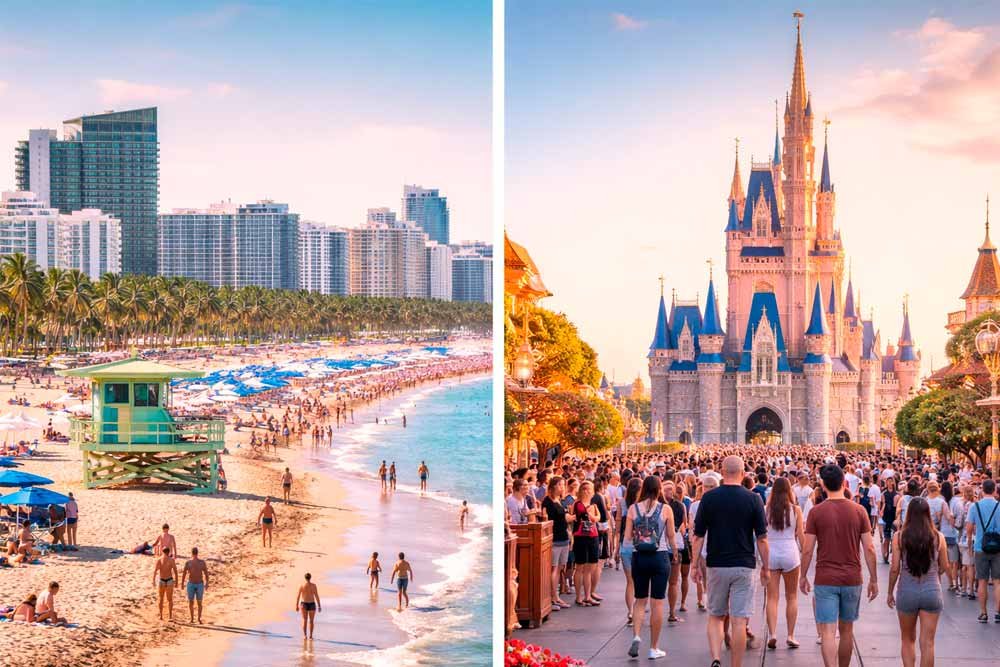
Miami and Orlando offer two completely different versions of Florida, and picking the wrong one can change the entire tone of your vacation. While Miami thrives on beaches, world-class nightlife, and a sophisticated cosmopolitan atmosphere, Orlando is the undisputed king of theme parks and family-centric entertainment.
We analyze the logistics, travel times between the two, and the real-world costs to show you which city delivers exactly what you’re looking for in 2026.
These two Florida destinations are only a few hours apart by highway. But they are built for completely different types of travelers. Most people don’t regret going to Florida. They regret choosing the wrong version of it.
This is a direct, side-by-side comparison – cost, logistics, energy, profile, effort and common mistakes – so you can choose based on fit, not hype.
I’ve done both trips multiple times — with family, with friends, and as a couple. The disappointment never comes from the city itself. It comes from choosing the wrong one for your travel style.
The Real Structural Difference
Miami is a living city that happens to receive tourists.
Orlando is a tourism engine that happens to be a city.
That distinction explains nearly every difference below.
Miami’s appeal is atmosphere: beaches, neighborhoods, food, nightlife, culture, aesthetics.
Orlando’s appeal is engineered experience: theme parks, resort ecosystems, controlled entertainment, predictable itineraries.
If you expect Orlando-level structure in Miami, you’ll feel lost.
If you expect Miami-level spontaneity in Orlando, you’ll feel restricted.
Cost Breakdown: Where the Money Actually Goes
Both destinations are expensive in different ways.
Hotel Costs
Miami
- Prime areas (South Beach, Brickell) command high nightly rates.
- Boutique hotels dominate desirable zones.
- Resort fees and parking fees can add up.
- Choosing the wrong neighborhood can increase transportation costs.
Orlando
- Resort hotels near parks are expensive.
- On-property Disney hotels add premium pricing.
- Off-site hotels are cheaper but require driving.
- Vacation homes can reduce per-person cost for families.
Miami pricing reflects real estate value and location prestige.
Orlando pricing reflects proximity to parks and convenience.
Food & Dining
Miami
- Restaurant culture is strong.
- Trend-driven pricing.
- International cuisine.
- Easy to overspend without noticing.
Orlando
- Theme park food is marked up.
- Dining plans and character meals inflate totals.
- Off-site dining can lower costs.
- Meals are often planned, not spontaneous.
Miami drains gradually through lifestyle.
Orlando spikes through structured spending.
Attractions & Entertainment
Miami
- Beach access is low-cost.
- Museums, boat tours, nightlife are optional add-ons.
- Many experiences depend on what you choose.
Orlando
- Theme park tickets are unavoidable if parks are your goal.
- Multi-day tickets increase total commitment.
- Lightning Lane adds premium layers.
- Entertainment is built into the core itinerary.
In Miami, you can scale spending up or down.
In Orlando, baseline spending is already high.
Energy & Emotional Experience
Miami: Social and Aesthetic
Miami is visually driven.
- Strong nightlife presence
- High-end restaurants
- Fitness and body culture
- International crowd
- Street-level unpredictability
It feels alive.
For some travelers, that’s exciting.
For others, it feels overwhelming or superficial.
If you don’t enjoy social environments, Miami can feel isolating rather than energizing.
Orlando: Structured and Contained
Orlando is engineered.
- Controlled environments
- Clear park boundaries
- Planned daily structure
- Predictable family rhythms
- Clean tourist zones
It feels organized.
For some, that’s comforting.
For others, it feels artificial or repetitive.
If you dislike queues, scheduled rides and tightly managed spaces, Orlando can feel exhausting.
Planning Requirements
Miami allows flexibility.
You can:
- Change plans mid-day
- Explore neighborhoods spontaneously
- Adjust pace easily
Orlando requires strategy.
You must:
- Book in advance
- Understand park logistics
- Schedule rides
- Manage time precisely
Lack of planning in Miami reduces optimization.
Lack of planning in Orlando reduces enjoyment.
Miami vs Orlando With Kids
For young children, Orlando almost always wins.
The entire ecosystem is designed around families:
- Safety
- Attractions
- Character experiences
- Clear entertainment goals
Miami offers beaches and attractions, but it is not engineered around children.
Parents expecting Disney-scale engagement in Miami often feel disappointed.
Adults expecting nightlife energy in Orlando often feel under-stimulated.
Miami vs Orlando for Adults or Couples
Without children, the comparison shifts.
Miami offers:
- Rooftop bars
- Cultural districts (Wynwood, Little Havana)
- Walkable urban pockets
- Oceanfront atmosphere
Orlando offers:
- Relaxed resort stays
- Theme park nostalgia
- Structured entertainment
- Slower evenings outside parks
If you value energy and dining culture, Miami fits better.
If you value simplicity and shared experiences, Orlando can be easier.
Transportation & Layout
Miami
- Some areas are walkable.
- Rideshare works but adds up.
- Parking costs matter.
- Staying in the wrong neighborhood increases friction.
Orlando
- Car rental is almost mandatory.
- Resorts are spread out.
- Distances between parks are significant.
- Driving is part of daily routine.
Miami punishes poor location choice.
Orlando punishes lack of transportation planning.
Common Disappointments
Why People Feel Disappointed in Miami
- Expected Disney-style magic
- Chose remote hotel areas
- Underestimated dining costs
- Don’t enjoy nightlife culture
- Wanted more structured entertainment
Why People Feel Disappointed in Orlando
- Underestimated physical exhaustion
- Don’t enjoy waiting in lines
- Wanted authentic urban exploration
- Dislike highly controlled environments
- Didn’t plan reservations early enough
Disappointment usually comes from mismatch, not from destination failure.
Who Should Choose Miami?
Choose Miami if:
- You enjoy real city energy
- Restaurants matter to you
- You prefer flexibility
- You don’t need structured days
- You’re traveling as adults
Who Should Choose Orlando?
Choose Orlando if:
- Theme parks are the primary goal
- You’re traveling with young children
- You prefer clear daily schedules
- You don’t mind planning ahead
- You value predictability over spontaneity
What About Splitting the Trip?
Some travelers attempt both.
A Miami–Orlando split trip can work if:
- You have at least 8–10 days.
- You understand the pace shift.
- You treat each city as a separate experience.
Without enough time, splitting reduces depth and increases travel friction.
Final Decision
If you want it simple:
- Choose Miami for lifestyle, beaches, food, nightlife and adult energy.
- Choose Orlando for theme parks, structured attractions and kid-focused trips.
The wrong choice happens when expectations don’t match the city’s core identity.
Miami and Orlando do not compete.
They serve different expectations.
If you choose based on social media imagery, one of them will disappoint you.
If you choose based on your personality, budget tolerance and energy level, neither will.
The right decision isn’t about popularity.
It’s about alignment.
At Miami The Hype, we focus on helping you match expectations with reality — so your money goes where your profile actually fits.