
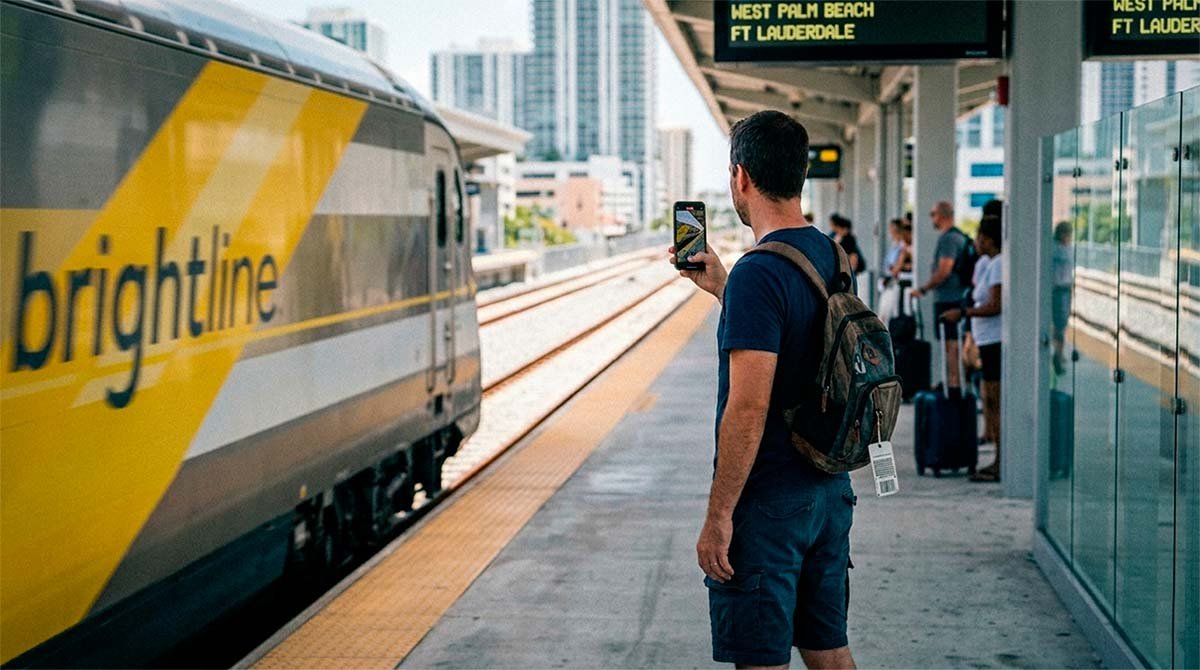
I’ll tell you the exact moment I stopped thinking of Brightline as “the Orlando train.” I was on I-95 near Fort Lauderdale, dead stopped, watching brake lights stretch out further than I could see, and a Brightline train went by on the elevated track next to the highway like none of that applied to it. I wasn’t envious of the seats or the Wi-Fi. I was annoyed that I’d been treating a six-station regional rail line like a one-trick theme park shuttle for months.
Here’s what nobody tells you when they pitch Brightline as “the train to Orlando”: that’s one route out of six stations, and it’s arguably not even the most useful one if you live here or visit often. Miami, Aventura, Fort Lauderdale, Boca Raton, West Palm Beach, Orlando — that’s the full line, and most of it has nothing to do with theme parks. I’ve ridden it enough times now, for enough different reasons, to have real opinions about which stops are worth your time, which fare tier is a waste of money, and where the whole system quietly falls apart.
This is everything — how it works, what it actually costs once you stop trusting the homepage number, station by station, when it beats a car, when it doesn’t, and the stuff that goes wrong that nobody puts in the brochure.
Is Brightline Worth It?
Yes, if you’re traveling solo or as a couple and your destination is walkable from the station — it’s faster than driving, cheaper than you’d think for short hops, and you skip parking entirely. It gets shakier the moment you’re a group of three or more on a quick regional trip, where Uber or a rental car for the day often comes out cheaper per person. The honest case against it isn’t the train itself — it’s what happens on either end of the ride once you’re off it.
How the Whole Thing Actually Works
Two ticket classes exist: SMART and PREMIUM. SMART is the one you’ll book 90% of the time — leather seats, free Wi-Fi that actually holds up on a video call, a power outlet at every seat. PREMIUM gets you maybe two extra inches of seat width, a quieter car with fewer people in it, free snacks and drinks, and a separate lounge before boarding.
I went through the same arc a lot of regular riders describe: booked PREMIUM the first few times because it felt like the “right” way to do it, then started questioning what I was actually paying for on a 35-minute ride to Fort Lauderdale. The lounge and the free drinks make sense on the long haul to Orlando, where you’re sitting for three and a half hours and the lounge access genuinely replaces a meal you’d otherwise buy at the station. On a short regional hop, you’re paying extra for a seat you’ll be in for less time than it took you to clear the turnstile. I’ve gone back to SMART for everything except Orlando, and I don’t think I’m leaving anything on the table.
Booking happens through the app or website, and the pricing moves like an airline’s — cheapest several weeks out, climbing as the train fills or your date gets closer. I’ve watched the same Miami-to-Fort-Lauderdale route price itself at $15 one week and $36 the next, same time slot, just different booking windows. There’s no trick to it beyond booking earlier than you think you need to.
Boarding is genuinely fast, which is the one part of the experience that consistently lives up to the marketing. You scan a QR code at a turnstile, walk through a quick security scan — no laptops out, no liquids removed, just a walk-through — and you’re at the platform. Boarding opens about ten minutes before departure and the turnstiles lock four minutes before the train leaves, so showing up at departure time means you’re watching it pull away without you.
Every Station, What It’s Actually For
Forget the brochure descriptions. Here’s what each stop is good for in practice, and where I’d skip it.
| Station | Best For | Skip It If | Connects To |
|---|---|---|---|
| MiamiCentral | Anchor station for a car-free Miami trip; walk to Kaseya Center, direct Metromover access | You’re not staying anywhere near downtown or Brickell | Metrorail, Tri-Rail, Metromover, MIA shuttle (~$12) |
| Aventura | Aventura Mall (covered walking bridge, no transfer needed), Hard Rock Stadium events | Your trip has nothing to do with the mall or a stadium event — there’s little else here | Local bus routes, mall shuttle |
| Fort Lauderdale | Flagler Village, Las Olas Boulevard, a real no-car day trip from Miami | You need more than an afternoon — it’s a half-day stop, not a basecamp | Short rideshare to the beach, Riverwalk |
| Boca Raton | Quick stop if you already have business in Boca | You’re checking a bag — no checked baggage service here at all since Dec 2025 | Limited; mostly rideshare from here |
| West Palm Beach | Clematis Street, The Square (formerly CityPlace), a solid bate-volta | You want nightlife density — it’s quieter than Fort Lauderdale | Palm Tran local bus |
| Orlando (MCO) | The long northbound run — different trip, different math entirely | You think it drops you near the parks. It doesn’t. | MCO Terminal C, rideshare to Disney/Universal |
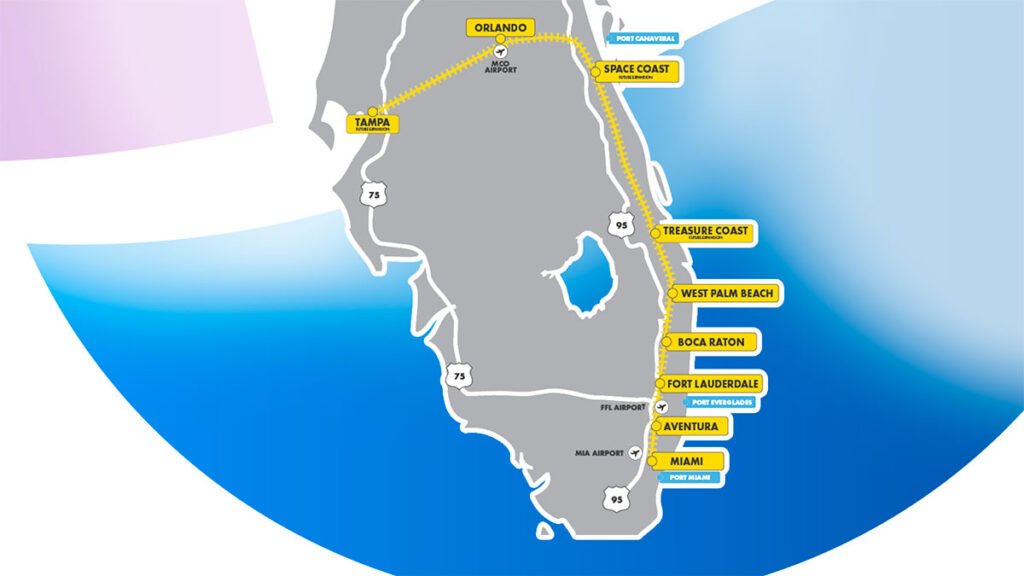
Just a quick heads-up if you’re looking at the official map: you’ll notice Tampa sitting at the very west end of the line. Don’t let that throw you off when planning your trip. Right now, the actual train service only runs as far north as Orlando. The extension to Tampa is still a future expansion project. If you are looking to book a ticket today, the active line strictly operates between Miami and Orlando, with stops in Aventura, Fort Lauderdale, Boca Raton, and West Palm Beach.
MiamiCentral
This is the station that makes everything else on this list possible, honestly. It’s not just where you catch the train — it’s plugged into Metrorail, Tri-Rail, and Metromover, which is free and covers most of downtown and Brickell. If your hotel sits on a Metromover stop, this station becomes your transit hub for the whole trip, not just the days you’re riding Brightline. I’ve used the airport connector shuttle from MIA into MiamiCentral more than once specifically to avoid an airport-hour Uber surge, and at around $12 it’s not close — that surge pricing at MIA during a busy arrival window can easily double or triple a normal fare.
Aventura
This is a one-purpose station, and I mean that as a compliment, not a knock. There’s a covered pedestrian bridge that takes you straight from the platform to the mall entrance — you never touch a car or a rideshare. It’s also the closer stop if you’re heading to a Hard Rock Stadium event. But if your trip has nothing to do with either of those two things, there’s genuinely not much reason to get off here. It’s not a neighborhood you’d explore on foot.
Fort Lauderdale
Probably my favorite regional stop, and the one I’d point a first-timer to if they wanted to test whether a car-free South Florida day trip actually works. Flagler Village has turned into a real walkable pocket — breweries, coffee, murals, the kind of density Aventura doesn’t have. Las Olas and the beach are a short ride from the station if you want to extend the day. It fills an afternoon comfortably without needing a rental car once you’re off the train.
Boca Raton
The station I have the least to say about, which is itself useful information. It’s small, it’s quiet, and unless you already have a reason to be in Boca specifically, I wouldn’t build a day around it the way I would Fort Lauderdale. The one thing worth flagging clearly: as of December 2025, Boca Raton dropped checked baggage service entirely. If you’re traveling with anything bigger than a carry-on, it’s riding with you as overflow, for a fee, or it’s not riding at all.
West Palm Beach
Surprised me the first time — it’s closer to Clematis Street and The Square than I expected walking out of the station. It’s a quieter scene than Fort Lauderdale, less bar-crawl energy, more “nice dinner and a walk” energy. Good bate-volta candidate if you want a change of pace without committing a whole rental car to the day.
Orlando
Orlando Station gets its own section, because it’s not really the same category of trip as the other five: Brightline Miami to Orlando.
Who This Actually Makes Sense For
I’m solo or traveling as a pair most of the time I use Brightline, and that’s not a coincidence — the math works best at that group size. You’re not splitting four tickets, you’re not stacking rideshare costs for four people on both ends, and the Wi-Fi onboard is solid enough that I’ve genuinely gotten work done on the Fort Lauderdale leg instead of treating the ride as dead time.
Where it stops making sense is obvious once you’ve watched the receipt grow. A family of four doing a short regional hop is paying for four full-price tickets on a route where a rideshare or a rental car for the day splits four ways instead of multiplying. I’ve seen people get to the station, do the math out loud once they see the per-person total, and quietly decide to drive next time. That’s not Brightline failing — it’s just the wrong tool for that group size on a short trip.
Heavy luggage is the other dealbreaker. If you’re checking a bag on a 35-minute hop, you’ve added a 20-to-30-minute early-arrival requirement and a $10-25 fee to a trip that’s barely longer than the check-in window itself. At that point you’ve built an airport experience around a subway-length ride.
What I’d Tell Someone Renting a Car Anyway
Not everyone reading this is trying to go car-free, and that’s fine — plenty of trips genuinely need a car for the full stay. Even then, Brightline is worth knowing about for the specific legs where a car is actively a worse choice than the train.
The clearest case is the airport run. If you’re flying into MIA or FLL and your first stop is downtown Miami or Fort Lauderdale, taking the Airport Connector Shuttle into Brightline and skipping the rental car pickup line entirely — then grabbing your rental a day or two later once you’re settled — can save you the worst part of arrival day: the rental counter line and the unfamiliar-city drive while jet-lagged. I’ve recommended this exact sequence to people who insisted they needed a car for the whole trip, and most of them still ended up using the train for at least one leg once they saw what MIA’s rental counter lines looked like on a Saturday.
The other case is a one-off city hop in the middle of a car trip. If you’re already renting for a week and want to spend a day in Fort Lauderdale or West Palm Beach without driving and finding parking there, leaving the rental car at the hotel and taking the train for that single day is often less hassle than circling for a parking spot in an unfamiliar downtown.
Brightline vs. Renting a Car
For one or two people doing a handful of city-to-city hops, Brightline usually wins outright. A SMART ticket on a short South Florida route, plus a rideshare on each end, typically lands below what a rental car costs for the day once you count gas and parking. That math flips hard at three-plus people, because a rental car’s price doesn’t multiply per passenger and a stack of train tickets does.
There’s a softer cost too, one that doesn’t show up on a receipt: finding parking. Driving into Fort Lauderdale or downtown Miami on a busy weekend can burn 15-20 minutes circling a block you didn’t budget for. The train just deposits you at a station.
Brightline vs. Uber
This isn’t really a fair fight within Miami itself — Uber wins for getting across town, full stop. Brightline isn’t built to compete there. Where it pulls ahead is the city-to-city leg specifically. An Uber from Miami to Fort Lauderdale during peak traffic can run $60-80 and take well over an hour with zero guarantee on timing. A SMART ticket booked a couple weeks out frequently costs less and takes a predictable 30-40 minutes regardless of what I-95 is doing that day.
The setup I actually use most: train for the city-to-city leg, Uber for the last mile on each end. Neither tool does the whole job alone.
What It Actually Costs
The fare on the homepage is the floor, not a realistic expectation. I’ve watched the exact same South Florida route price itself at three different numbers depending purely on how far out I booked and what day of the week I was traveling. Weekday, booked a few weeks ahead, lands near the floor. Friday evening, booked that morning, can run two or three times higher for the identical seat.
There’s a group discount worth knowing about, mostly because of how often it gets misunderstood: groups of three or more get an automatic 25% off SMART and SMART Saver fares — but only for trips starting or ending in Orlando, only within 60 days of booking, and it doesn’t touch PREMIUM fares at all. If you’re a group of four doing a short Miami-to-Fort-Lauderdale trip, this discount simply isn’t available to you. It’s an Orlando-route perk, not a systemwide one, and I’ve seen people assume it applies everywhere and get surprised at checkout.
Where It Goes Wrong (And It Does, Sometimes)
I’d be lying if I said every ride has been flawless, and you’ll find plenty of riders online who’ll tell you the same. The pattern in most of the bad experiences isn’t the train breaking down — it’s what happens during a delay. Brightline shares track with freight and other rail traffic, and incidents at grade crossings do happen; when they do, trains get held, sometimes for hours. The complaint that comes up again and again isn’t “the train was late,” it’s “nobody told us anything while we waited.” Packed station, minimal announcements, a phone line that doesn’t pick up. That’s the actual risk profile here — not constant breakdowns, but occasionally poor communication during the rare delay.
Smaller, more common annoyances: shuttle services from the airport to the station not showing up reliably, which leaves you scrambling for a rideshare from a pickup zone that isn’t built for it. Checked bags occasionally not making it to the right station on time. None of this is universal — I’ve had plenty of clean, on-time rides — but it’s frequent enough in other people’s accounts that I’d rather you know going in than find out the hard way on a tight connection.
Mistakes That Actually Cost You Money
Not validating parking at MiamiCentral: The garage charges full drive-up rates unless you validate through the app or at guest services. Skip that step on a multi-day trip and it adds up fast.
Checking a bag on a short hop without checking the rules: $10-25 depending on size, a 20-to-30-minute early arrival requirement, and zero checked baggage availability at Aventura or Boca Raton. For a 35-minute ride to Fort Lauderdale, that turns a quick trip into a longer production than the ride itself.
Assuming the Orlando station drops you near a theme park: This trips up almost every first-timer doing the Orlando run. Brightline’s Orlando station sits inside MCO airport’s Terminal C — nowhere near Disney or Universal. You’re still arranging a rideshare or shuttle from there.
Booking same-day or next-day on a popular route: I’ve seen this double the price of a ticket that would’ve cost half as much booked a week out.
How It Plugs Into Everything Else
MiamiCentral isn’t an island — it sits next to Metrorail and Tri-Rail, and connects directly into Metromover, which is free. That combination does most of the heavy lifting for a car-free Miami trip: land at MIA, take the Airport Connector Shuttle into MiamiCentral for around $12, and from there you can reach most of downtown without calling a single rideshare.
If FLL is your arrival airport instead, the same shuttle system runs from the Fort Lauderdale station, and it’s usually both cheaper and more predictable than an airport-hour Uber during a surge window.
When This Is Actually an Orlando Trip
Everything above is about Brightline as a regional tool — getting between South Florida cities without a car, catching a game, a day trip to Fort Lauderdale. The same train also runs the full route up to Orlando, and that’s genuinely a different trip with different math: a longer ride, real last-mile logistics once you land inside MCO, and pricing that behaves differently than the short regional hops covered here.
If that’s the trip you’re actually planning — Miami to the parks, not Miami to Fort Lauderdale for the afternoon — I went deep on the real numbers in a separate piece: what it costs for a group once you stop trusting the marketing fare, the MCO last-mile problem nobody mentions, and when renting a car still beats the train outright. You can find that breakdown in my Brightline Miami to Orlando cost and logistics piece.
Brightline FAQ
Is PREMIUM worth it for a short trip like Miami to Fort Lauderdale?
Not in my experience. The lounge and free snacks earn their keep on the long Orlando run, where you’re sitting for hours. On a 30-40 minute hop, you’re paying for amenities you won’t have time to use.
Can I use Brightline just to get to a Heat game or a Hard Rock Stadium event?
Yes, and it’s one of the more practical regional uses of the whole system. MiamiCentral is a short walk from Kaseya Center, and Aventura is the closer stop for Hard Rock Stadium. Brightline also runs complimentary event shuttles for select games, which show up as a booking option.
Does Brightline replace a car entirely if I’m staying in Fort Lauderdale?
For getting to Miami or West Palm Beach, yes. For getting around Fort Lauderdale itself once you’re off the train, you’ll still lean on Uber or walking outside Flagler Village and Las Olas.
What happens if I miss my train?
Tickets are tied to a specific departure time. Miss it, and you’ll need to modify your reservation through the app or a kiosk — usually paying the fare difference for the next available train, which can be steep if it’s last-minute.
How often does Brightline actually run late?
Often enough that I wouldn’t book it for something with zero flexibility, like a flight with a tight connection. Most delays trace back to track incidents rather than mechanical issues, and the real complaint pattern isn’t the delay itself — it’s spotty communication while you’re waiting. Build in buffer time if your plans depend on arriving exactly on schedule.