

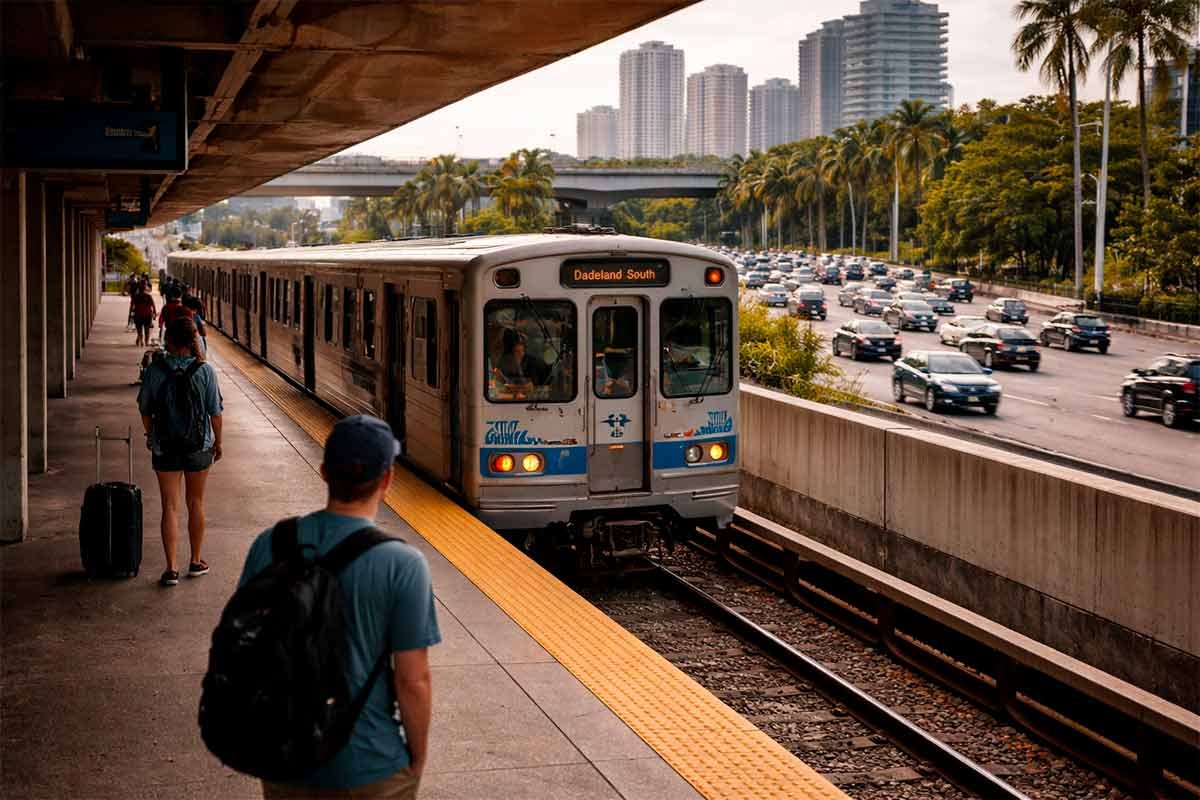
In Miami, a car can feel like the obvious choice right up until your day runs through the airport, Brickell, or Downtown at the wrong hour. That is when Metrorail stops looking like a backup plan and starts looking like one of the smartest moves in the city. Not for every route, and not for all of Miami, but often for the exact part of town where driving starts eating time, energy, and money.
That is the real decision here.
Not whether Miami has good public transportation in general. It does not work equally well everywhere. The better question is simpler: when does Metrorail save you from the worst part of getting around Miami?
For some trips, the answer is very clear.
The short version
If your day includes Miami International Airport, Brickell, Downtown, Coconut Grove, South Miami, or Dadeland, Metrorail can be a much smarter option than many visitors expect. It will not fix every transportation problem in Miami, but it can make central, time-sensitive trips far more predictable.
That alone matters.
In Miami, predictability is often more useful than the fantasy of driving “faster.”
Why Metrorail can make more sense than a car
The biggest advantage of Metrorail is not that it turns Miami into New York.
It does not.
Its value is more practical than that. It helps you skip the part of the day that gets annoying fast: traffic building at the wrong time, slow garage access, expensive parking near your destination, and the constant need to think about where the car will go next.
That is why Metrorail works best as a decision tool, not as a citywide ideology.
You do not use it because trains are automatically better. You use it when the rail corridor lines up with your day better than driving does.
Where Metrorail works best
Metrorail is strongest when your route stays close to the airport-to-central-south spine of Miami.
That includes trips tied to:
- Miami International Airport
- Brickell
- Downtown
- Coconut Grove
- Coral Gables-area access points
- South Miami
- Dadeland
This is where the system starts feeling genuinely useful instead of theoretical.
If your hotel is near one of those stations, or your day is built around one of those zones, Metrorail can help you avoid the usual “Miami time loss” that happens between leaving one place and actually arriving at the next.
The strongest use case: airport to Brickell or Downtown
This is where Metrorail makes the most immediate sense for many travelers.
If you land at Miami International Airport and your next stop is Brickell or Downtown, driving is not always the smart move just because it is direct. Airport traffic, pickup confusion, ride-app surge pricing, and garage costs can make a simple city transfer feel more draining than it should.
Metrorail often cuts through that problem well.
You are not choosing the train because it is glamorous. You are choosing it because it removes several ways the trip can go sideways. On arrival day, that matters. On departure day, it matters even more.
For travelers staying in Brickell or spending time in Downtown, rail can be one of the cleanest ways to start the trip without wasting energy early.
What Metrorail does better than driving
A car gives you flexibility. That is true.
But flexibility is not always the same as efficiency.
There are days in Miami when the car gives you more options and less peace of mind at the same time. Metrorail becomes valuable when it removes small but expensive losses: lost minutes, missed timing, garage costs, and the mental drag of driving into busy central areas.
| What usually goes wrong | Driving | Metrorail |
|---|---|---|
| Traffic gets worse than expected | Common | Avoided on the rail segment |
| Parking near the destination | Often expensive or annoying | Usually removed from the equation |
| Airport arrival stress | High on busy days | Often simpler for central destinations |
| Event-night traffic | Can get ugly fast | Usually easier if your route fits the system |
| Time predictability | Weak in busy windows | Much better in the right corridor |
That does not mean Metrorail always wins.
It means it wins in the places where Miami driving starts becoming inefficient.
Why Brickell changes the math
Brickell is one of the clearest examples.
A lot of people look at the map and assume driving into Brickell is normal, then figure out the rest later. Sometimes that works. Sometimes it turns a short plan into a slow one.
Brickell is exactly the kind of place where Metrorail starts making more sense than people expect. Not because Brickell is impossible by car, but because the total cost of driving is bigger than just the ride itself. You are dealing with traffic, access, parking, and the possibility that a simple dinner, meeting, or check-in becomes more tiring than it should be.
If your day includes Brickell and starts somewhere along the rail corridor, the train deserves serious consideration.
Metrorail plus Metromover is where the system gets much better
This is the part many generic pages do not explain well enough.
Metrorail is often only half of the solution. Metromover is what makes the last part of the trip work better inside the urban core.
If you are heading into Downtown or Brickell, the combination matters a lot. Metrorail gets you into the area. Metromover helps you move around it without turning the final stretch into another parking decision or another short ride request.
That is what makes this transportation choice stronger than it first appears.
Used alone, Metrorail can already help. Used with Metromover, it starts solving a much more complete central Miami day.
The park-and-ride move most visitors ignore
You do not need to choose between “car all day” and “no car at all.”
That is where many people overcomplicate Miami transportation.
Sometimes the smartest move is to use the car only until it stops being useful. Drive to a station outside the busiest core, park there, and let rail handle the part of the city where traffic and parking get worse.
That is especially helpful for people who are staying outside the core, meeting friends in Brickell, catching an event in Downtown, or trying to reduce the cost and hassle of central parking without giving up the car completely.
This is one of the most practical ways to use Miami transportation well: not by forcing one method to do everything, but by letting each part of the trip do what it does best.
When Metrorail is a smart choice and when it is not
This is the simplest way to judge it.
| Trip pattern | Smart choice? | Why |
|---|---|---|
| Airport to Brickell hotel | Yes | Strong fit for a central arrival |
| Airport to Downtown | Yes | One of the cleanest central transfers |
| South Miami to Brickell dinner or meeting | Usually yes | Good fit when timing matters |
| Dadeland to Downtown event | Often yes | Helps you avoid central driving stress |
| Brickell and Downtown day | Yes, especially with Metromover | Strong central combination |
| Miami Beach-focused trip | Usually no | The system is not built around the beach |
| Outlet day or scattered errands | Usually no | Too many disconnected stops |
| Late-night, all-over-the-city plans | Often no | Door-to-door flexibility matters more |
That is the key point.
Metrorail works best when your day is linear. It works much worse when your day is scattered.
When I would not rely on it
Metrorail is not the right answer for every visitor.
I would not build my day around it if most of the plan is in Miami Beach, if I am bouncing between unrelated neighborhoods, if I have a lot of luggage and multiple transfers, or if the whole day depends on door-to-door convenience late at night.
I would also be careful about forcing rail into a plan just because it looks cheaper on paper. A cheaper ride is not automatically a better ride if the route stops making sense.
This matters because Miami transportation is not about choosing a “good” or “bad” system. It is about matching the tool to the day you actually have.
How to use Metrorail well
A few simple decisions make a big difference.
First, use it for one clean corridor, not for a messy all-day zigzag across Miami.
Second, think about the last part of the route before you commit. If your endpoint is Brickell or Downtown, that is where Metromover makes the whole plan stronger.
Third, use the train when timing matters. Airport days, business meetings, dinner reservations, game nights, and event traffic are all situations where predictability becomes more valuable.
Fourth, do not treat driving as the default winner. In Miami, the car is often the obvious option right until it starts wasting your time.
Is it worth it?
For the right trip, yes.
Not because Metrorail is perfect. Not because it works everywhere. And not because Miami suddenly becomes easy without a car.
It is worth it because there are parts of Miami where driving looks more convenient than it really is. Metrorail helps most when it removes the expensive part you were about to accept as normal: congestion, parking stress, and lost time in the middle of the day.
That makes it one of the smartest transportation choices in Miami for a specific kind of traveler: the person whose route actually matches the system.
If that is your trip, it can save more than money. It can save momentum.
For a broader look at what works and what does not across the city, read our Miami Public Transportation Guide. If you are trying to decide whether ride apps make more sense for your schedule, How Much Uber and Lyft Really Cost in Miami for a Typical Tourist Day is a useful next read. And if your whole plan depends on staying central enough to move around without driving, Can You Stay in Miami Without Renting a Car? helps with that decision.