
Some Miami purchases feel smart in the store and disappointing a few hours later. The price looked good, it felt worth it at the time, and the trip made the decision feel easy — until tax, luggage space, return hassle, and real-life use changed the math.
That does not mean shopping in Miami is a bad idea. It means the smartest trips usually come down to knowing what to skip, not just what to buy.
The most expensive shopping mistake in Miami is not overpaying for one item. It is coming home with a bag full of things that never really made sense.
I’m not writing this from the outside. I’ve made enough shopping mistakes in Miami to know that a good-looking buy and a good decision are not always the same thing.
Quick answer: what usually is not worth buying in Miami
| Category | Why people still buy it | Why it often disappoints |
|---|---|---|
| Rushed electronics | Old belief that U.S. tech is always cheaper | After tax, the gap may be small, and many people compare the wrong version |
| Big outlet hauls | Feels like saving | Quantity takes over and quality judgment disappears |
| Bulky items | Good shelf price | Hard to pack, fragile, awkward, easy to regret |
| Random beauty hauls | Familiar brands, big selection | Heavy, repetitive, and often bought without real need |
| Tourist-zone impulse buys | Easy, fun, emotional | High markup, low long-term value |
| Coupon-driven purchases | The promo feels smart | The deal only works if the math is real, not imagined |
Electronics that are no longer automatic deals
Electronics are still part of the Miami shopping conversation. They just need more discipline than they used to.
A lot of weak purchases start with the same shortcut: “It’s cheaper in the U.S., so I should buy it here.” Sometimes that still works. Often it does not work as cleanly as people expect.
Florida retail purchases still carry sales tax, and Miami-Dade can add local surtax, so the number on the shelf is not the real number you are paying. That alone shrinks more “deals” than many travelers expect.
Then comes the second mistake: comparing the category instead of the exact product. People compare “an iPhone,” “a laptop,” or “a camera” instead of the precise model, storage, year, accessories, and support situation they will actually live with later.
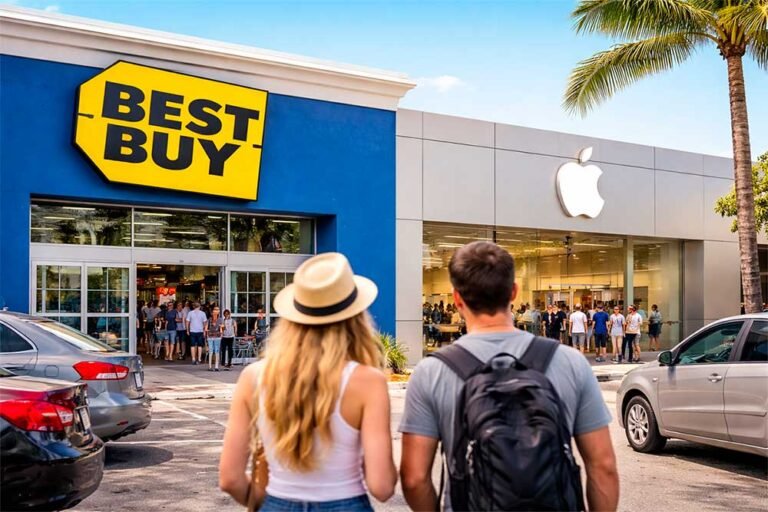
Apple products are the clearest example. A planned Apple purchase can still make sense. A rushed one often does not. Current U.S. iPhone 17 models use eSIM technology for U.S. activation, which is fine for many buyers and annoying for others, depending on carrier habits and where they live.
The safer electronics buys in Miami are usually:
- chargers
- cables
- selected headphones
- accessories
- one specific device you researched before the trip
The weaker ones are usually:
- expensive devices chosen inside the store
- products bought just because the U.S. price “sounds lower”
- bulky electronics with little real savings
- anything you did not compare carefully
A simple rule helps here: if you only decided to buy it after seeing it in Miami, be more suspicious of the purchase.
If you are comparing where to buy Apple products specifically, Best Buy vs Apple Store Miami is the better next step.
Outlet shopping that feels smarter than it is
Outlet shopping is not automatically a bad idea. It just becomes a bad idea very easily.
The trap is simple: people stop judging products and start judging discount tags. That is how a mediocre shopping day starts feeling like a success. You bought a lot. That does not mean you bought well.
This is especially common with:
- clothes you would not have noticed at home
- sneakers that felt exciting only because they looked discounted
- bags or accessories you never planned to buy
- “cheap enough” basics that become luggage filler
A lower price per item is not the same as a better purchase.
Outlet shopping usually works best when you arrive with a shortlist. A few brands. A few categories. A price range that still makes sense after tax. The day usually gets worse once it turns into a hunt for anything that looks reduced.
That is also why “big haul” content creates the wrong mental model. Many people do not need more shopping energy in Miami. They need better filters.
If your trip includes outlets, Best Outlets in Miami should help you separate strong stops from weak ones.
Bulky purchases that are bad travel buys
Some products are not bad products. They are bad products to bring home from a trip.
That includes:
- kitchen appliances
- fragile décor
- heavy home goods
- giant multipacks
- oversized beauty bottles
- awkward boxes
- anything that turns your suitcase into a problem
This is one of the most overlooked shopping mistakes in Miami. A product can still lose badly even if the shelf price looked good. Once you add checked-bag cost, extra weight, breakage risk, or just the annoyance of carrying it around, the value can disappear fast.
A good Miami purchase usually travels well. A weak one asks too much from the rest of your trip.
If you need a simple test, use this one: would you still want this item if you had to pack it tonight and carry it through the airport tomorrow? If the answer is shaky, the purchase probably is too.
Beauty products that looked smarter on the shelf
Beauty is still one of the strongest shopping categories in Miami. It is also one of the easiest places to overbuy.
The weak beauty purchase is usually not the one luxury item you really wanted. It is the oversized haul. The trendy product you never planned to use. The giant lotion, the extra cleanser, the random shelf find that felt exciting for four minutes.
This is where people confuse recognition with value. They see familiar brands, wide selection, and shelves that feel more abundant than back home. That can be useful. It can also make ordinary buying look smarter than it is.
Beauty usually works best in Miami when the purchase is:
- small
- practical
- easy to carry
- clearly useful after the trip
- something you actually meant to buy
It works worst when the logic becomes: “I know this brand, so this must be worth it.”
If you want the positive side of this category, What to Buy in Miami covers the stronger beauty and skincare angles.
Clothes and sneakers you only bought because you were in Miami
This is where a lot of harmless-looking waste happens.
A cheap shirt you never wear is expensive enough. The same goes for sneakers you liked only because the trip made them feel more exciting.
Clothing can still be a strong Miami category when the purchase is specific: basics, sportswear, denim, a well-priced pair of sneakers you already wanted, or one practical item that fits real life after the trip.
It becomes weak when shopping turns into entertainment and the bag starts filling itself.
A few warning signs:
- you are buying in volume, not with purpose
- you would not have noticed the item at home
- you are saying “it was cheap” more than “I really wanted it”
- you already know some of it will sit untouched later
Cheap enough to buy is not the same as good enough to keep liking.
Tourist-zone purchases that are weak by design
Tourist shopping often fails for a very predictable reason: the item is being sold for mood, convenience, and impulse, not long-term value.
That is why generic Miami merch, random beach-store products, flashy souvenir bundles, and “I should buy something here” purchases disappoint so often. They are easy to buy and easy to forget.
This does not mean every souvenir is bad. A souvenir can still be worth it if it is small, useful, or genuinely meaningful. But a lot of tourist-zone shopping is just overpriced urgency in a nicer package.
The question is not whether you can afford the markup. It is whether the item will still matter once the trip is over.
Luxury buys that depend too much on the moment
Luxury shopping in Miami is not automatically a mistake. But it becomes a weak decision fast when the atmosphere is doing more work than the product itself.
That can happen in polished stores, high-end malls, and shopping areas designed to make purchases feel bigger than they are. The trip makes the purchase feel special. The store makes it feel important. Neither one proves value.
A luxury item can still make sense if it was already on your list, already researched, and still feels right after tax. It becomes weaker when the real reason is emotional momentum.
Travel mood is expensive. That is worth remembering before you let a nice store finish the decision for you.
A bad buy can sometimes be fixed — but it is still a bad buy
One useful thing about shopping in the U.S. is that many major retailers do allow returns for change of mind, including items bought in physical stores, as long as the item and timing fit the store’s policy.
That can save you from carrying a weak purchase through the rest of the trip. Target, for example, says most unopened items in new condition returned within 90 days can receive a refund or exchange, while Best Buy also allows returns but lists category-specific limits and final-sale exceptions.
That matters more than people think.
Sometimes the smartest move is not the original purchase. It is walking back into the store the next day after the hotel-room reality check. You looked at the item calmly, compared better, and realized it was not worth the money or the luggage space.
That said, returns should never become the plan.
Policies vary by retailer, product type, condition, receipt, packaging, and promotion. Final sale, clearance, some electronics, and some discount-store purchases can be stricter or nonreturnable.
So yes, a weak purchase can sometimes be reversed. But a purchase you need to undo was still weak. It still cost time, attention, and part of your trip.
Coupons, rebates, and store credits: when they help and when they don’t
This is another area where people talk themselves into bad purchases.
A real discount can improve the decision. A coupon applied now at checkout can absolutely change the math. A price match can help. A clean store promotion can make a borderline buy look much better.
But not every “saving” is really a saving.
A rebate is not the same as money already saved. A future store credit is not the same as paying less now. A “buy more to save more” offer can easily turn a reasonable purchase into a bloated one.
This matters even more for travelers. A next-purchase coupon is only useful if you will actually use it. A future credit is weak if it pushes you into spending more during the trip just to justify the first purchase.
The simplest rule is this: a coupon can improve a good purchase, but it does not magically turn a bad one into a smart one.
What may still be worth buying — just in the right version
This is not a “do not shop in Miami” page. It is a page about buying with cleaner judgment.
Electronics can still make sense when the model is exact and the purchase was researched. Beauty can still be one of the best categories when the products are useful and easy to bring home. Clothing and sneakers can still work when you buy selectively instead of treating every discount as a victory. Even outlets can still be worth it when you are shopping for specific items, not trying to prove that the trip was productive.
The category is often not the real issue. The wrong version of the category is.
A better Miami shopping filter
Before buying anything in Miami, ask yourself:
- Is this still a good deal after tax?
- Would I buy this if I were not traveling?
- Is it clearly better priced or harder to find than at home?
- Will it fit in my luggage without creating extra cost or annoyance?
- If this turns out to be weak, is fixing it worth my time?
- Am I buying the product, or the moment around it?
- Is the promo helping the purchase, or pushing me into more purchase than I wanted?
That short filter cuts out a surprising amount of waste.
Miami still works best when the purchase is planned, practical, or genuinely harder to replicate where you live. It works worst when shopping becomes a mood, a quantity game, or a way of proving the trip was worth it.
Sometimes leaving with fewer bags is the smarter version of shopping well.
FAQ
Is shopping in Miami still worth it?
Yes, but more selectively than many people expect. Miami still works well for some beauty products, selected electronics, practical travel gear, and carefully chosen clothing or sneakers. It works less well when the purchase is impulsive, bulky, or easy to buy at home for about the same money.
Can I return something I bought in a Miami store if I change my mind?
Often yes, especially at larger retailers, but it depends on the store, the item, the condition, the receipt, and whether the purchase was final sale or clearance. Always check the policy before assuming the purchase can be undone.
Are Miami outlets always worth it?
No. They can be worth it for specific planned purchases, but they often become weak shopping decisions when quantity replaces judgment and discount tags do all the thinking.