
The transportation question in Miami doesn’t start at the airport. It starts when you book your hotel — you just don’t know it yet.
Half of Miami’s visitors rent a car because “Miami is a car city.” The other half decide to Uber everywhere because they’ve heard parking is brutal. Both instincts contain truth. Neither is automatically right.
Here’s what actually happens: the couple who rents a car drives to South Beach, checks into their hotel, and discovers valet is $55 a night — because self-parking doesn’t exist at most Miami Beach properties. The solo traveler who decides to Uber everywhere spends three comfortable days until a weekend concert pushes a $22 ride to $68. Both paid more than they planned. Neither ran the full numbers before leaving home.
This guide runs those numbers. By neighborhood. By traveler type. By the specific days of your trip.
The Full Cost Stack (Stop Comparing the Wrong Numbers)
The mistake most visitors make is comparing the rental car’s daily rate against an average Uber fare. That comparison is missing three to four line items on each side.
Rental car real cost: Base daily rate + Airport concession surcharge + State and county taxes + Hotel parking (per night) + Destination parking + Toll transponder rental or SunPass charges + Gas on return
A car that lists at $40/day at MIA clears checkout at $70–$95 once airport-specific fees stack up. Add $50/night in hotel valet for five nights in South Beach and you’re looking at $250 in parking costs for a car you may have driven twice.
Uber and Lyft real cost: (Base fare × rides per day) × trip days + surge multipliers during events and peak hours
Off-peak, a ride from South Beach to Wynwood runs $18–$25. The same ride during Art Basel, Ultra Music Festival, or a busy Saturday night: $45–$80. Uber is not a fixed transportation budget — it’s a variable, and Miami generates more surge triggers than most cities its size.
Public transit real cost: $2.25 per trip, capped at $5.65/day for Metrobus and Metrorail combined. The Metromover — covering Downtown, Brickell, Park West, and the Arts & Entertainment District — is free.
The formula that actually matters:
Real Transportation Cost = (Daily mode cost × days) + parking + surge exposure + time lost to traffic
For specific Uber fare estimates across common Miami routes, Miami Uber costs breaks down what you’ll actually pay per trip before you commit to anything.
Where You’re Staying Determines the Winner
This is the variable that generic travel guides skip entirely. “Which option is cheaper” is not a city-wide question — it’s a question about your base.
South Beach
The rental car math collapses here, fast. Street parking on Ocean Drive and Collins Avenue runs $6/hour for non-residents. A three-hour dinner out costs $18 just to leave the car nearby — and that assumes you find street parking, which is not guaranteed on a Friday night. Valet at South Beach restaurants starts at $20–$25. Hotel valet runs $40–$60/night with taxes included.
Visitors who spend the least on transportation in South Beach treat it like a walkable neighborhood — because the beach strip largely is one. Walk to the sand, catch the free South Beach Local trolley along Washington Avenue for short hops, and Uber for anything beyond a 15-minute radius. The car in that equation isn’t freedom; it’s overhead with a nightly billing cycle.
If you’re still deciding where to base your trip, best areas to stay in Miami without a car maps the neighborhoods where the car-free math actually holds.
Brickell and Downtown
The free Metromover covers the entire corridor from Brickell City Centre north through Kaseya Center and into the Arts & Entertainment District. A full day of local movement costs nothing in transit. The Metrorail extends the reach south to Coconut Grove, Coral Gables, and Dadeland, and west to MIA. For a trip centered on restaurants, waterfront bars, and urban neighborhoods, a rental car from a Brickell hotel is largely redundant — it just costs more to park than it saves in convenience.
Wynwood and the Design District
Ride-based destinations. Wynwood street parking runs $3.40/hour, and during weekend nights, finding a spot on NW 2nd Avenue means circling blocks for 20–30 minutes before you’ve done anything useful. Drop off at the door, pick up at the door. The car adds a parking expense and a frustration tax to a night that should be straightforward.
Doral, Airport Area, and Aventura
The dynamic reverses. Hotel parking in these areas is often included or minimal. Distances between destinations are longer — Dolphin Mall is 6 miles (9.7 km) from MIA, Sawgrass Mills is 20 miles (32 km) from South Beach. Uber fares compound quickly when each ride covers 8–12 miles (13–19 km). If the itinerary involves outlet shopping, suburban restaurants, or spread-out destinations, a rental car earns its keep — especially for groups splitting the cost.
Miami Beach vs. the Mainland
One variable that rarely gets named directly: crossing the causeways repeatedly is a cost in itself. The MacArthur Causeway and Julia Tuttle Causeway add 15–30 minutes to any trip during peak hours, whether you’re driving or sitting in an Uber. If your hotel is on the beach and your activities are mostly on the mainland — or vice versa — that crossing compounds daily. Budget for it in time and in fare.
The Traffic Tax
Miami traffic is a budget line, not a footnote. It affects every transportation option and makes every cost estimate wrong if you leave it out.
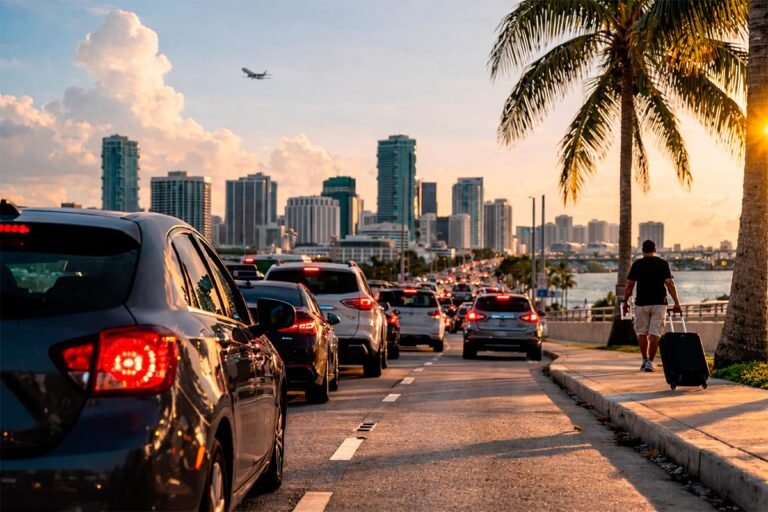
The distance from MIA to South Beach is roughly 9 miles (14.5 km). In rush hour — weekdays from 7:30–9:30 AM or 4:30–7 PM, any Friday after 3 PM — that’s 45–60 minutes in a car or Uber. During a large event at Hard Rock Stadium or a cruise week at PortMiami, add surge pricing on top of the traffic time.
A rental car doesn’t escape this. You’re sitting in the same gridlock, burning gas, and then circling for parking at the end of it.
The city’s infrastructure explains why: Miami was built around the car, but its road network wasn’t designed for its current density. The I-95 corridor, the Brickell bridge bottlenecks, and the limited causeway capacity into Miami Beach create structural congestion that doesn’t resolve quickly. Why Miami traffic is so bad covers the specific choke points. The best time to drive in Miami — the site’s most-read traffic post — gives the actual windows when roads clear and the hours to avoid entirely.
The practical read: if your day involves crossing between Miami Beach and the mainland more than once, build 30–45 minutes of buffer per crossing into both your schedule and your transportation budget.
Two Scenarios: What the Math Actually Looks Like
The Default Move
A couple flies into MIA on a Saturday for seven nights in South Beach. At the rental counter, they pick up a compact at $45/day — $315 base before any fees. After the MIA airport concession surcharge, Florida state tax, Miami-Dade county tax, and a toll transponder add-on: the rental clears at approximately $820–$860.
Their South Beach hotel charges $55/night valet. Self-parking isn’t available. Seven nights: $385.
Over the week, they drive to Wynwood twice, once to Coconut Grove, once to Sawgrass Mills. Total meaningful mileage: roughly 130 miles (209 km). The car sits in the hotel garage the rest of the time, billing by the night.
Total transportation spend: $1,200–$1,250, plus gas.
The Smart Move
Same trip. Same hotel neighborhood. Different sequencing.
They Uber from MIA on arrival — $35 off-peak on a Saturday afternoon. Over the first four nights, they walk the beach, catch the free South Beach Local trolley along Washington Avenue, and take Uber for evening runs — four rides averaging $22 each. Total for four days: $123.
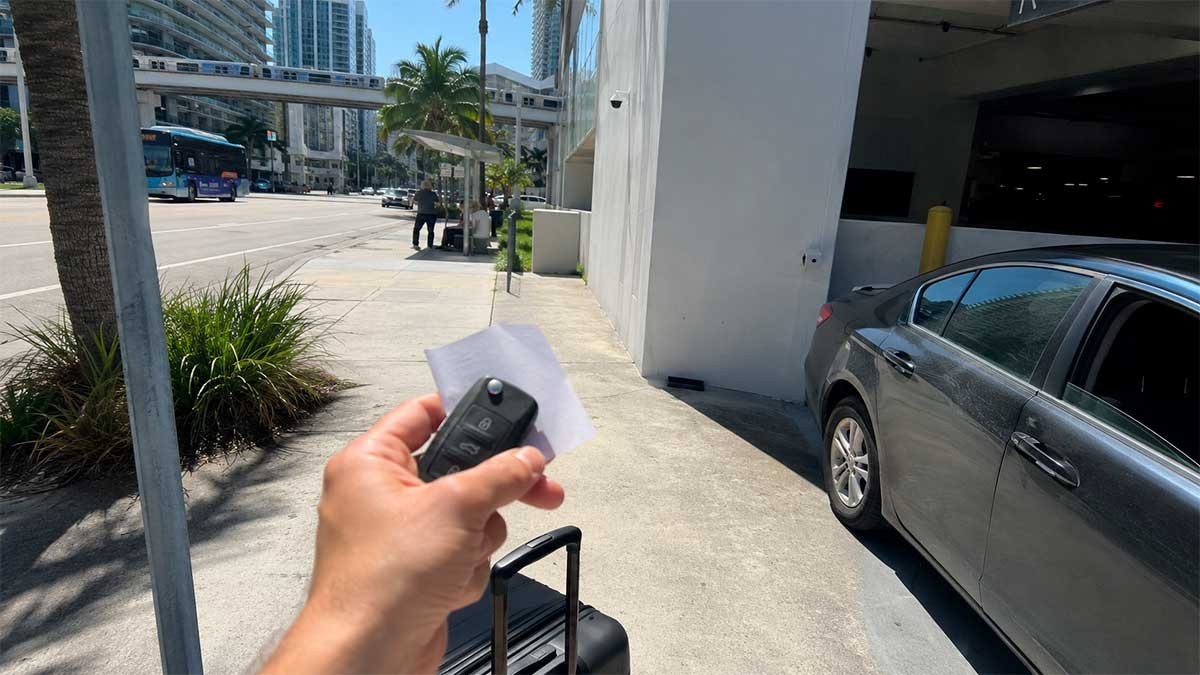
On day five, they pick up a rental from a non-airport Miami Beach location — lower base rate, no airport concession surcharge. They keep it three days for Sawgrass Mills, a Coconut Grove afternoon, and a run toward the Everglades. Three-day rental, no hotel parking charge because they return the car on checkout morning: approximately $155.
Uber from the rental return to their departure hotel: $18.
Total transportation spend: $296.
The gap is roughly $950. Same itinerary. Same hotel area. The difference comes from two decisions: not renting from MIA on day one, and not paying hotel valet for a car parked still most of the week.
Renting a car in Miami — is it worth it? covers the full list of scenarios where the rental math actually tips in your favor.
The Hybrid Play (The Most Underused Strategy)
The most cost-effective Miami transportation approach isn’t choosing one option for the whole trip — it’s sequencing them to match what each day actually demands.
The logic: use rideshare, walking, and free transit for beach days and urban nights. Bring in the rental car only when the itinerary calls for real driving — day trips, outlet shopping, destinations that need wheels and cheap parking at the other end.
When each option wins:
| Situation | Best Option |
|---|---|
| Beach days and restaurant nights, South Beach base | Uber + free trolley + walking |
| Downtown or Brickell-centered itinerary | Free Metromover + Uber for longer runs |
| Day trip to the Keys, Everglades, or Sawgrass | Rental car for those days specifically |
| Group of 3–4 with a spread itinerary | Rental car — split cost beats per-ride Uber |
| Late-night return from Wynwood or NW 2nd Ave | Uber — parking and driving not worth it |
The specific move that saves the most: delay the rental pickup. If your first two days are South Beach-based with no day trips on the schedule, there’s no reason to take a car from MIA on arrival. Hold the reservation, Uber from the airport, and pick up from a city location when you actually need it. The real cost of parking in Miami shows how fast hotel-night parking fees add to the total when you do the math across a full stay.
Public Transit: What It Can and Can’t Do
Miami’s public transit is real, functional, and widely underestimated — and also genuinely limited in the places visitors care most about.
The Metrorail runs 24.4 miles (39.3 km) across 23 stations, connecting MIA, the Health District, Downtown, Brickell, Coconut Grove, Coral Gables, and northward toward Hialeah. Peak headways: 10 minutes. The Metrobus network extends to Miami Beach via Route 150 to South Beach and Routes 119 and 120 along mid and upper Collins Avenue. Daily fare cap across both systems: $5.65. The Metromover within Downtown and Brickell: free, no exceptions, no card needed.
What it doesn’t cover well: late-night service drops significantly after 11 PM, weekend frequencies on many Metrobus routes fall to 30–60 minute headways, and coverage in Aventura, Wynwood, and the Design District is thin enough that most visitors end up calling an Uber anyway.
Miami public transportation covers the full network and realistic use cases. Metrorail and Miami traffic addresses specifically when rail beats driving — and on certain corridors, it does, more often than visitors expect.
The honest position: transit works well as part of a plan, not as the entire plan. For Brickell and Downtown-based visitors, it can eliminate a real share of the Uber spend. For South Beach stays, the free trolleys handle specific corridors, and Metrobus covers the rest at low cost. As a full replacement for rideshare or a rental car across all Miami scenarios — the system isn’t there yet.
How to Build Your Miami Transportation Budget
There’s no single answer. There is a clear framework based on where you’re staying and what your itinerary actually looks like.
South Beach, 3–5 nights, beach-focused: Budget $25–$40/day for Uber and walk the rest. Skip the rental unless a day trip is specifically on the schedule.
Brickell or Downtown, any length: Metromover covers the core. Uber fills the gaps. Budget $15–$30/day. A rental car for the full stay is rarely justified.
Mixed itinerary, 5+ nights: Hybrid approach — Uber for the first half, rental from a city location for road-trip days. Averaged across the trip: $35–$60/day.
Doral, Airport area, or Aventura base: Rent the car for the full stay, and verify hotel parking costs before assuming they’re included.
| Traveler Type | Recommended Approach | Approx. Daily Cost |
|---|---|---|
| Solo, South Beach | Uber + trolley + walking | $20–$35 |
| Couple, Brickell or Downtown | Metromover + Uber | $15–$30 |
| Family, spread-out itinerary | Rental from city location | $65–$90 all-in |
| Group of 3–4, week-long trip | Hybrid — Uber first, car for road trips | $30–$50 per person |
Frequently Asked Questions
Do I need to rent a car for my Miami trip? Not necessarily — and not for the full trip even if you end up renting one for a few days. South Beach and Brickell visitors regularly come out ahead without a car. If your itinerary includes the Florida Keys, the Everglades, or Sawgrass Mills, get a rental specifically for those days and return it before the hotel parking clock restarts.
Is Uber reliable in Miami? Reliable enough for most situations. The exceptions: late nights in Wynwood and Brickell, major event weekends like Art Basel and Ultra Music Festival, and MIA arrivals during peak hours when the rideshare pickup queue runs long. On those occasions, build extra buffer time and check the surge estimate before confirming — pricing can double the base fare without much warning.
Is Miami public transportation usable for tourists? Yes, selectively. The free Metromover is genuinely useful within the Downtown and Brickell corridor. The Metrorail handles the MIA-to-Brickell run and the southward corridor efficiently. Miami Beach has free trolleys covering key corridors. The gaps appear after 11 PM and in neighborhoods like Wynwood, Aventura, and the Design District, where transit alone doesn’t close the loop.
What’s the most expensive transportation mistake in Miami? Renting a car at MIA on day one, parking it at a South Beach hotel for the full stay, and paying both the airport concession surcharge and $50+/night in valet — for a car that moves twice during the entire trip. That single combination can add $700–$950 to a week’s transportation bill. Run the full parking cost breakdown before committing to a rental-plus-hotel-valet setup.