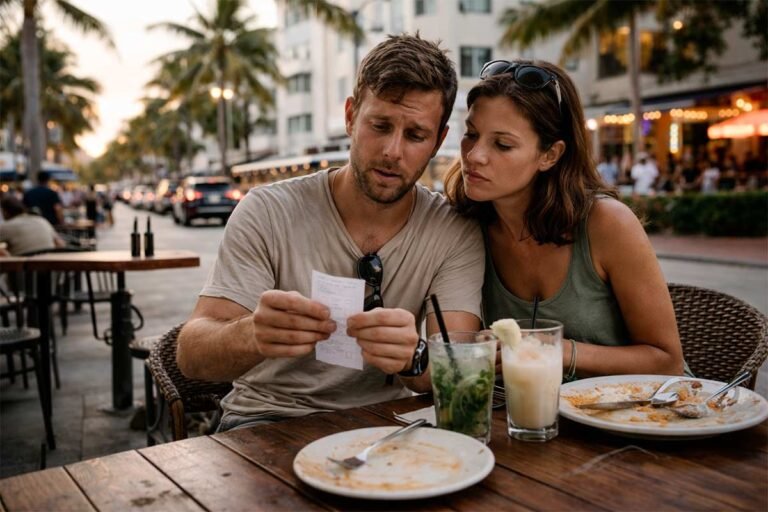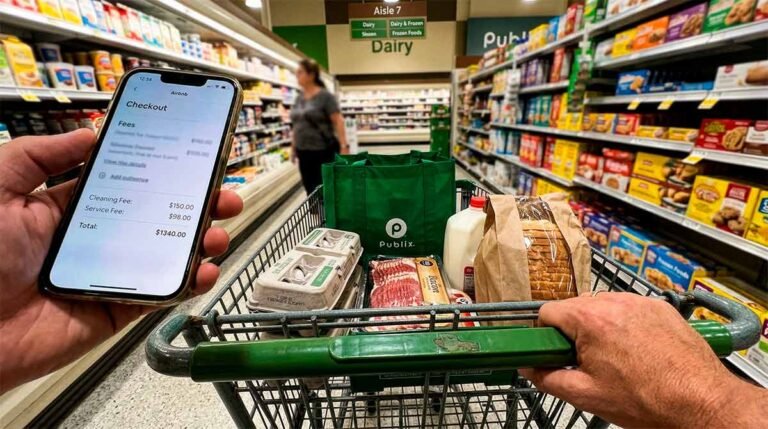

The first mistake solo travelers make in Miami happens before they even land: budgeting like a couple’s trip, then dividing by two. That math doesn’t work here because almost nothing in Miami’s hospitality pricing scales down for one person — not the resort fee, not the minimum bar tab some restaurants quietly enforce, not the rideshare minimum that charges the same $12-18 base fare whether you’re alone or with three friends. A traveler running solo numbers against a couple’s budget template will consistently underestimate the trip by 35-50%, then get blindsided at checkout. The fix isn’t cutting corners blindly — it’s knowing which three line items (lodging format, dining structure, and after-dark transit) actually move the needle, and which ones are just tourist-trap noise that locals never pay.
Miami’s pricing structure was built for two people splitting a bill, a cab, and a hotel room. Solo travelers don’t get a discount for using half the inventory — they get the same room rate, the same resort fee, the same valet charge, divided by one instead of two. That gap has a name in the hospitality industry (the single supplement), and in Miami specifically, it shows up in three places at once: where you sleep, where you eat, and how you move after dark.
None of those three problems get solved by “just be careful” advice. They get solved by picking the right neighborhood density, the right dining format, and the right transit pattern before you book anything.
The Financial Logic: What Solo Actually Costs Here
Run the math before you run the trip. A standard Miami Beach hotel room in shoulder season prices out around $180-220 a night before resort fees (typically $35-45 added at checkout, regardless of occupancy) and before the 13% combined sales and resort tax. Split between two people, that’s roughly $115-145 per person, per night. Traveling alone, you absorb the entire $215-265 real daily cost — room, fees, tax — by yourself.
Compare that to a boutique hostel like Freehand Miami, where private rooms run as low as $99-186 a night depending on season (verified current rates), or a dorm bed starting around $31-67 a night in low season. The private room option alone can cut your accommodation cost by 40-60% compared to a standard hotel room, without dropping you into a bunk bed if that’s not your style.
The second variable nobody calculates: transportation pattern. A room in Doral or near the airport might look cheaper at booking, but if your actual plans center on South Beach, Brickell, or Wynwood, you’re paying $28-45 each way in rideshare fares just to reach where you’re spending your day — and that’s at non-peak pricing. A ride from Brickell to South Beach on a quiet weekday afternoon might run $15. The same trip during dinner-hour demand can climb well past that. Multiply either number by two trips a day for a five-day trip, and a “discount” hotel eight miles from the action stops being a discount.
Real Daily Cost (Solo) = Room Rate + Resort Fee + Tax + (Average Daily Rideshare Spend)
Run that formula against both a Doral budget hotel and a Mid-Beach boutique stay, and the walkable option frequently wins — not because the room is cheaper, but because the total cost of access is lower.
Cracking the Single Accommodation Cost
The fix isn’t “find a cheaper hotel.” It’s “buy your way into a neighborhood with density,” because density is what eliminates the rideshare line item that quietly inflates solo travel budgets.
Boutique hostels solve this two ways at once. First, the per-night rate is structurally lower than hotel inventory because the business model doesn’t assume double occupancy revenue. Second — and this is the part most cost guides skip — these properties cluster in exactly the walkable zones (Mid-Beach, South Beach core) where you don’t need a car or a daily Uber budget to reach restaurants, the beach, and nightlife.
Freehand Miami (2727 Indian Creek Dr.) is the clearest example of this model done well for solo travelers specifically. It’s a renovated art deco building one block from the beach, offering both dorm beds and private rooms in the same property, which means you can downgrade or upgrade mid-trip depending on budget without changing hotels. Two on-site bars (Broken Shaker among them) function as a built-in social layer — useful for solo travelers who want company without the work of finding it. Rates fluctuate seasonally (expect the low end in August, the high end in peak winter months), so check current pricing before locking dates rather than trusting a number from a year-old blog post.
Hotel Rendale Miami Beach is the other stable name worth knowing in this category — a social-hostel model with female-only dorm availability, an on-site pool, and a location built around foot traffic rather than driving distance.
If hostels aren’t your style, the same logic applies to small boutique hotels in Brickell or Mid-Beach: pay slightly more per night for the location, and let that premium cancel out your rideshare spend instead of stacking on top of it.
The Hidden Cost That Breaks This Math
Resort fees are mandatory and occupancy-blind. A $40 resort fee costs a couple $20 a head. It costs a solo traveler the full $40. Before booking anything described as a “resort” or “beach hotel,” search the property name plus “resort fee” — Miami Beach properties are notorious for burying this in fine print, and it’s rarely included in the rate you see on the search results page.
The Bar-Counter Dining Strategy
Solo dining in Miami has a structural advantage that doesn’t get explained clearly anywhere: in Brickell and the Design District specifically, bar-counter seating isn’t a workaround — it’s the default culture, because both neighborhoods run on a daytime population of professionals eating alone on lunch breaks. That means the awkwardness factor most solo-dining advice warns about simply doesn’t exist in these two zones the way it might in a tourist-heavy strip like Ocean Drive.
The mechanics: skip the host stand, walk straight to the bar, and order as you would at a table. You get full menu access, a server’s attention, and — if you want it — conversation with the bartender or whoever’s next to you, without the logistics of requesting a table for one on a Friday night. This works at sushi counters, ramen spots, and most mid-tier restaurants across both neighborhoods, and increasingly at higher-end spots too, where a seat at the bar gets you the same kitchen output as the dining room without a reservation.
Timing matters more than the strategy itself. Bar seating in Brickell fills up fastest during the 12:30-1:30 PM lunch window (the professional crowd) and again around 7-8 PM. Arrive at 6 PM or after 8:30 PM and you’ll have your pick of seats with zero wait, even at popular spots.
Tourist Trap Scenario vs. Smart Move Scenario
The Tourist Trap Scenario: You arrive in South Beach at 7:30 PM, walk into a hostess-driven restaurant on Ocean Drive, and ask for a table for one. Best case, you wait 20 minutes while two-tops sit empty around you. Worst case, you get seated at a table clearly built for four, tipping pressure goes up because the staff is mentally pricing the table’s potential, and the whole experience feels like an apology for showing up alone.
The Smart Move Scenario: You walk into a Brickell or Design District spot at 6:15 PM, sit at the bar, and order off the full menu. No wait, no hostess interaction, full attention from the bartender, and — because the format is built around quick, individual service — you’re in and out in 45 minutes if you want to be, or settled in for two hours if the conversation’s good. Same quality of food, none of the friction.
The difference isn’t the city. It’s choosing a neighborhood where the dining infrastructure already assumes some of its customers are alone.
Night Safety for Solo Travelers: Exact Boundaries, Not Vague Warnings
Most safety advice for Miami stops at “stay in well-lit areas.” That’s not a boundary — it’s a feeling, and feelings don’t help you decide whether to walk six more blocks or call a car. Here’s the version with actual edges.
Downtown Miami: During the day and through early evening (roughly until 10 PM), the core around Bayfront Park, Bayside Marketplace, and the Brickell-adjacent blocks of Biscayne Boulevard stays busy with foot traffic, event crowds, and visible security presence. Past 10-11 PM on a weeknight, that same foot traffic drops sharply on side streets one or two blocks off the main corridors — Flagler Street included. The rule that actually works: stay on Biscayne Boulevard or inside Brickell’s restaurant corridor after 10 PM, and treat any side street that looks empty as a side street that is empty.
Brickell: This is the most walkable-after-dark zone in the city for a solo traveler, largely because it’s a financial district with residential density layered on top — meaning there are always people coming home from dinner, the gym, or work, even at midnight. The restaurant and bar strip along SW 8th Street and Brickell Avenue stays comfortable to walk solo well past midnight. Step off that corridor into the quieter residential blocks west of it, and the calculus changes — not because it’s dangerous, but because there’s no longer anyone else around to make a bad moment less likely.
South Beach / Entertainment Districts: Ocean Drive and Collins Avenue stay loud and populated late, which cuts both ways — lots of people around, but also the city’s highest concentration of late-night alcohol-related incidents and petty theft. The actual boundary here isn’t a street, it’s the beach itself: don’t walk onto the sand after dark, solo or otherwise. It’s unlit, it’s outside the foot-traffic pattern that keeps the boulevard safe, and it’s the single most common location cited in late-night incident reports for this district.
The neighborhoods to skip after dark entirely, regardless of which zone you’re staying in: Overtown and Liberty City carry meaningfully higher nighttime risk and offer nothing a solo traveler needs that isn’t available elsewhere in the city. This isn’t about avoiding a “bad part of town” reflexively — it’s a specific, data-backed exception to an otherwise reasonable city to walk in alone.
Transit as a Safety Layer, Not Just a Logistics Tool
This is the piece almost every safety guide skips: Miami’s free Metromover (the elevated downtown loop) and the Brightline rail service double as safety infrastructure, not just transportation. The Metromover runs daily until midnight, looping through Downtown and Brickell with stops directly outside hotel-dense blocks — meaning you can get from a Brickell restaurant back to a Downtown hotel without ever needing a rideshare or a dark-street walk, as long as you’re moving before the service window closes.
The practical rule: check the Metromover’s last-run time before you commit to a late dinner if your hotel sits along its route. If you’re cutting it close, that’s your signal to book a rideshare instead of trying to “just make it” — a $10 Uber is cheaper than the gamble of jogging six blocks to catch the last loop. Brightline, similarly, connects Downtown’s MiamiCentral station to other South Florida hubs with secured, staffed stations — a meaningfully safer last-leg option than a long solo walk if you’re staying near a station and arriving late.
Cost-Benefit Snapshot: What a Real Solo Day Looks Like
| Category | Budget-Conscious | Comfortable Mid-Range |
|---|---|---|
| Accommodation | Hostel private room, $99-150/night | Boutique hotel, $220-280/night |
| Dining (2 meals) | Counter seating, $35-55/day | Sit-down casual, $70-110/day |
| Local Transit | Walking + Metromover (free) | Mix of walking + occasional rideshare, $20-30/day |
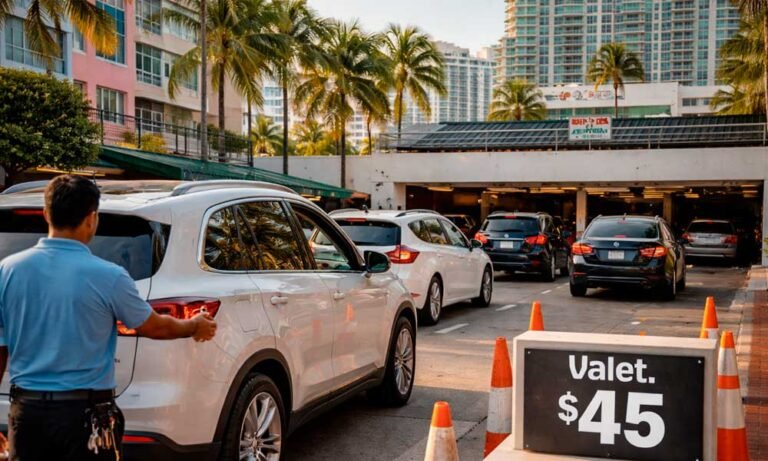
Add Florida’s 7% sales tax to every dining and retail transaction, plus the local hospitality standard of 18-20% tip on restaurant checks (often pre-added as a service charge for parties — verify before tipping again on solo checks, since this is a common solo-traveler overcharge). Valet parking, if you’re renting a car, typically runs $25-45 a night on top of the room rate at most Miami Beach properties — another cost that doesn’t shrink because you’re traveling alone.
Picking Your Miami Base as a Solo Traveler Comes Down to One Number
Not the nightly room rate. The real daily cost, transportation included. A $90 hostel bed eight miles from where you actually want to be can cost more by Thursday than a $180 boutique room two blocks from the restaurants, the beach, and a Metromover stop. Price the neighborhood, not just the room — and treat dining, accommodation, and your post-dinner walk home as three pieces of the same equation, because in this city, they are.
Frequently Asked Questions
Is it safe to walk alone in Miami after midnight?
In specific corridors, yes — Brickell’s restaurant strip and the main boulevards of South Beach stay populated well past midnight. Side streets and the beach itself are a different calculation; treat those as rideshare territory regardless of neighborhood.
How much more does solo travel actually cost in Miami compared to traveling with someone?
Expect to absorb 100% of fixed costs (resort fees, room tax) that a pair would split, plus a transportation line item that doesn’t exist for travelers who can split a rideshare. Choosing walkable accommodation cuts that gap significantly.
Is Brickell or South Beach better for a solo traveler?
Brickell wins on walkable safety and bar-counter dining culture. South Beach wins on nightlife density and beach access. Many solo travelers split a short trip between both rather than picking one.
Do I need a rental car for a solo Miami trip?
Not if you’re staying in Brickell, Mid-Beach, or South Beach. Between walking, the free Metromover, and rideshare for longer hops, a car adds valet costs without meaningfully improving access in these zones.