
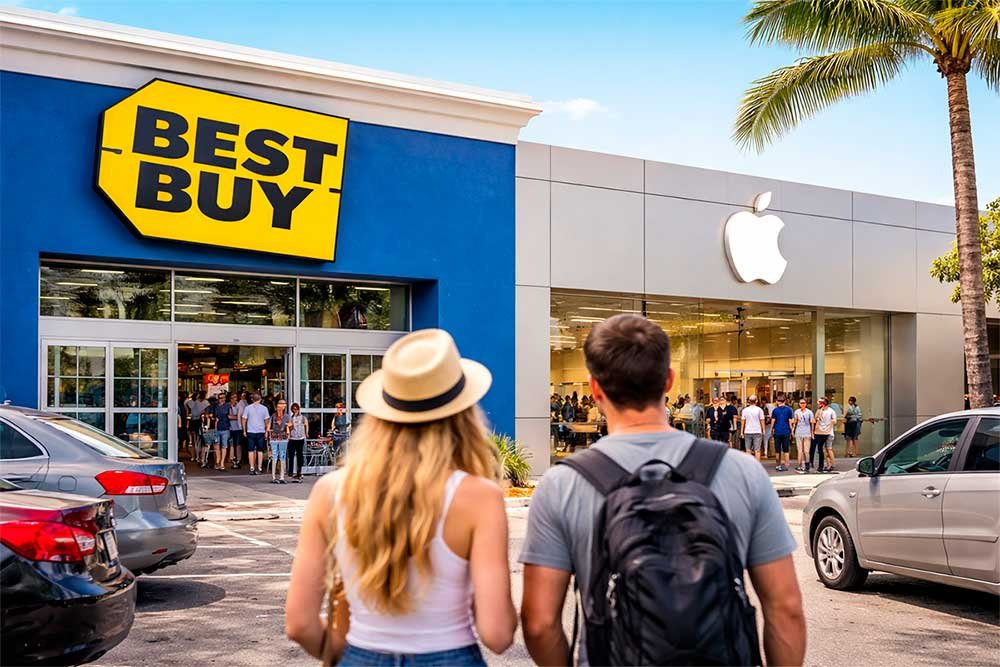
For a Miami visitor, buying Apple gear is not the same as buying it at home. You are comparing prices while dealing with sales tax, exchange rates, limited vacation time, luggage, receipts, and the fact that any problem may only appear after you leave Florida. That is why this Best Buy vs Apple Store decision needs a practical filter before the price comparison even starts. A cheaper device is only a better deal if it is the right model, the right condition, and the right buying path for an international shopper. In Miami, the Apple Store usually wins on simplicity and certainty, while Best Buy only becomes the smarter stop when the discount is meaningful enough to justify checking the details carefully.
Buying an iPhone or MacBook in Miami is usually not about finding a magical lower price. It is about avoiding the wrong kind of savings. For tourists, the real difference between Best Buy and Apple Store is not just what you pay at checkout. It is what you might get wrong on activation, compatibility, stock, returns, and how much certainty you have when you leave the store with an expensive device in your bag.
Both stores are legitimate. Both can be worth using. But they are not equally smart for every kind of buyer.
For most tourists buying a new iPhone, Apple Store is the safer choice. For some shoppers chasing a real discount, especially on open-box or simpler configurations, Best Buy can be the better value. The key is knowing where the deal is real and where the risk is doing too much of the work.
This Decision Is Not Really About Price
For most tourists, the real difference is certainty, not the number on the tag.
| Situation | Better choice |
|---|---|
| You want the safest iPhone purchase for international use | Apple Store |
| You want the clearest unlocked buying path | Apple Store |
| You found a meaningful open-box discount | Best Buy |
| You are buying a simple MacBook configuration and want value | Best Buy |
| You care more about certainty than chasing a small discount | Apple Store |
| You are comfortable checking every model detail before paying | Best Buy |
That is the real split.
This is one of those Spend Smart in Miami decisions where the sticker price matters less than the chance of making an annoying mistake on a short trip.
Why tourists often compare these stores the wrong way
A lot of people start with one question: which one is cheaper?
That sounds logical, but it is usually too shallow.
For newer Apple products, the base price gap is often small or nonexistent enough that price alone does not settle the decision. What changes the value is everything around it:
- whether the iPhone is clearly unlocked
- whether the model is eSIM-only
- whether the configuration you want is actually in stock
- whether the discount is strong enough to justify extra checking
- whether you are buying during a trip with limited time, limited baggage space, and no appetite for complications
That last part matters more than people admit.
A tourist buying electronics does not shop like a local. A local can come back tomorrow. A tourist usually wants to get it right once.
Apple Store: better when you want the cleanest purchase
For most international visitors, Apple Store wins on clarity.
That matters most with iPhones. When tourists say they want a phone that “works back home,” they are usually talking about three different things without separating them properly:
- unlocked status
- carrier setup
- SIM or eSIM compatibility
That is exactly where Apple Store becomes easier.
If your priority is buying a new iPhone with fewer doubts, Apple Store is usually the better answer. The purchase path is more direct, and that matters when you are spending serious money on a device you plan to use after the trip.
Apple Store also tends to make more sense when:
- you want a current model, not a bargain version of the decision
- you need a specific color or storage tier
- you do not want to second-guess the listing
- you would rather pay the normal price and leave with more confidence
That is why Apple often wins even when it does not feel like the “deal” store.
Best Buy: better when the savings are real
Best Buy becomes interesting when the purchase stops being a simple new-vs-new comparison.
That is where the store can actually beat Apple in value.
The strongest Best Buy scenarios are usually these:
- you found a real open-box discount
- you are buying an older Apple product
- you do not need a rare configuration
- you are comfortable reading the exact listing carefully
- the store fits your day better and saves time
This is the part many tourists miss: Best Buy is not automatically cheaper. It only becomes the smarter choice when the discount is meaningful enough to justify the extra attention.
A weak discount does not help much on a short trip. Saving a little and adding doubt is not a great trade.
Saving a real amount on an open-box MacBook or a straightforward Apple product? That is different.
The unlocked iPhone issue matters more than the sale sign
This is the point that deserves the most attention.
For tourists, buying the wrong iPhone is usually worse than missing a small discount.
That is why Apple Store has an edge. The store is usually the cleaner option for buyers who want the most straightforward path to an iPhone meant for international use. Best Buy can still work, but it asks more from the buyer. You need to slow down and verify exactly what you are buying.
Before paying, check:
- Is the iPhone clearly unlocked?
- Is there any carrier-linked setup involved?
- Are you buying a U.S. model that relies only on eSIM?
- Will your home carrier support that properly?
This is where many “good deals” stop feeling so good.
A tourist who buys too fast can end up taking home a phone that is technically fine but practically annoying. That is not a deal. That is just a more expensive mistake later.
eSIM changes the decision more than many travelers expect
This part deserves its own section because too many buyers still treat it like a footnote.
For a lot of international tourists, the question is no longer just “Is it unlocked?”
It is also “Will this setup make sense once I leave the U.S.?”
If you are used to physical SIM cards, or if your carrier at home handles eSIM poorly, this matters. A U.S. iPhone can still be a smart buy, but only if the device matches your real-world use after the trip.
That is why Apple Store often makes more sense for nervous or first-time international buyers. It is not about glamour. It is about reducing the chance of buying the wrong version of a very expensive product.
Price is only part of the real cost
Tourists love comparing shelf prices and ignoring the total decision cost.
That is backwards.
The real cost can include:
- sales tax
- transport to the store
- parking or ride-share cost
- international card fees
- time lost during a travel day
- baggage space if you are buying more than one item
- the cost of fixing a wrong purchase after the trip
That is why this page should not be read as a simple electronics price comparison.
It is a shopping decision inside a trip.
And trip decisions punish small mistakes more than normal shopping does.
Support and after-sale help
This part is less dramatic, but still important.
Best Buy is a valid place to buy Apple products. It is not some shady workaround. For many purchases, it is completely reasonable.
Still, buying directly from Apple usually feels cleaner when you want the purchase, setup, and support logic to stay in the same place. That simplicity has value, especially if something feels off and you want a more direct conversation about what you bought.
That does not mean Best Buy is bad. It means Apple Store tends to feel more straightforward.
For a tourist on limited time, straightforward is worth money.
So which one should most tourists choose?
Here is the honest version.
Choose Apple Store if:
- you are buying a new iPhone for international use
- you want the safest path, not the most tempting one
- you care about getting the exact model without second-guessing
- you do not want to gamble for a small discount
Choose Best Buy if:
- you found a real open-box or sale price
- you are buying a simpler MacBook or older Apple product
- you know exactly what to verify before paying
- the savings are strong enough to matter
That is the line.
Apple Store is usually better for certainty.
Best Buy is better only when the value becomes clearly real.
Where this fits in the bigger Miami shopping decision
This page helps you decide where to buy Apple gear in Miami.
The bigger question is whether buying Apple gear belongs on your Miami list in the first place. For that, read What to Buy in Miami, where the decision is not just store choice, but whether the purchase still makes sense once you add sales tax, luggage space, travel logistics, and the actual difference versus buying at home.
And before treating every U.S. electronics purchase as automatically smart, read What Not to Buy in Miami. Some products look attractive in-store but stop being good value once you account for tax, compatibility, small savings, or the simple fact that the trip itself already makes the purchase more expensive than it looks.
Apple Store or Best Buy: The Better Choice
For most tourists buying a new iPhone in Miami, Apple Store makes more sense.
Not because it is always cheaper. Usually it is not.
It makes more sense because it reduces the chance of buying the wrong thing, misunderstanding the setup, or saving too little to justify the extra doubt.
Best Buy becomes the smarter choice when the discount is real, the product is straightforward, and you are willing to check details carefully.
So this is the simplest way to frame it:
Apple Store is usually the safer buy. Best Buy is only the better buy when the savings are strong enough to be worth the extra checking.
That is the real comparison.
FAQ
Is Best Buy cheaper than Apple Store in Miami?
Not by default. For brand-new Apple products, the difference is often too small to decide the purchase on price alone. Best Buy gets more interesting when there is a real sale or open-box discount.
Should tourists buy iPhones at Apple Store instead of Best Buy?
Usually yes, especially if they want the clearest and lowest-risk purchase for international use. Apple Store tends to be the safer option for buyers worried about unlocked status, setup, or post-trip compatibility.
Is buying a MacBook at Best Buy in Miami worth it?
Sometimes. It can be worth it when Best Buy has a real discount on a configuration that already fits your needs. It makes less sense when the savings are small and the decision starts feeling more complicated than it should.