
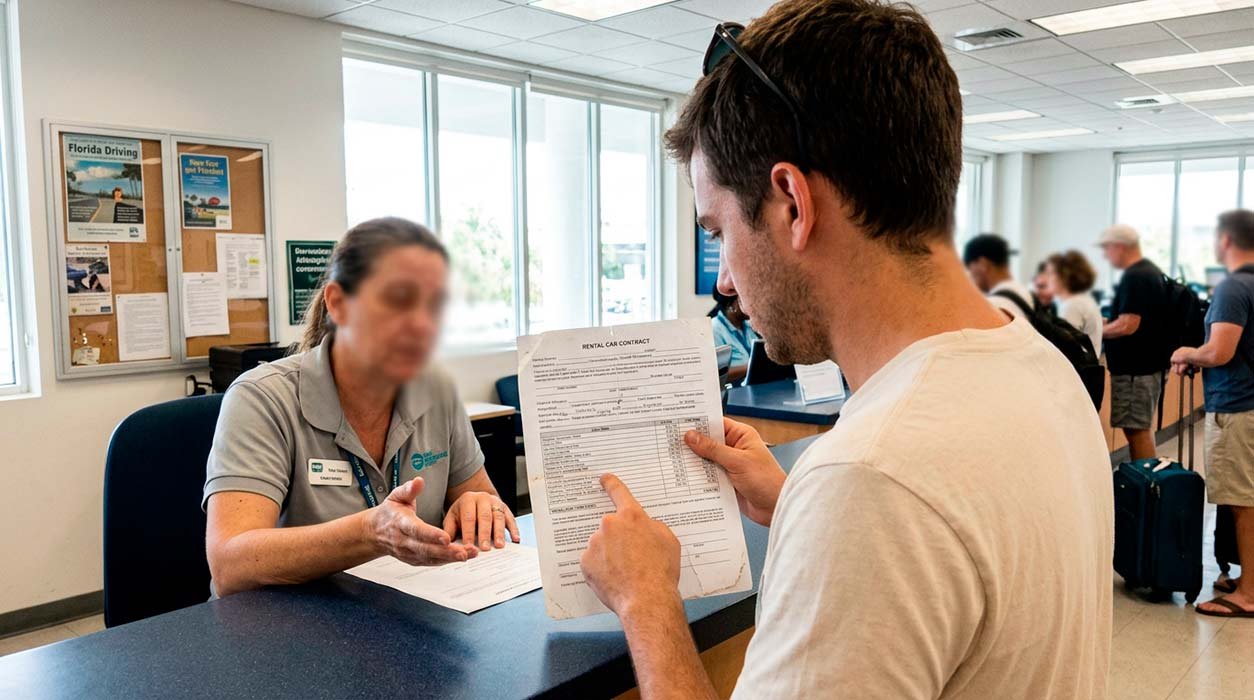
The daily rate on a Miami car rental is the smallest honest number you’ll see. What you actually pay is that rate plus airport and state fees, whatever toll program the company attaches, the insurance decision you make at the counter, hotel parking, and charges that can show up on your card weeks after you hand back the keys. This guide follows the money from the MIA counter to your card statement, in the order you’ll meet each charge.
I’ve rented at the airport and off-site. I’ve paid too much and I’ve paid very little. The difference was never the rate on the search page. It was what I decided before I reached the counter. If you’re still deciding whether you need a car at all, start with whether renting in Miami is worth it; this guide is for once you’ve said yes.
The Real Daily Cost: One Formula Before You Compare Anything
Stop comparing daily rates. Compare this:
Real daily cost = (base rate + taxes and airport fees + insurance you actually buy + toll fees + parking + fuel gap) ÷ days
| Line item | Where it hides | What to do |
|---|---|---|
| Base rate | The big number on the search page | Compare the same car class and dates |
| Taxes and airport fees | The last checkout screen | Compare totals, never rates |
| Insurance add-ons | The counter, after a long flight | Decide before you land |
| Toll program | A fee charged by the company | See the toll section below |
| Parking | Your hotel bill and garages | Check the nightly fee before booking a hotel in Miami |
| Fuel | Prepaid tank or refill charge | Return it full and keep the receipt |
Airport-related lines on a quote usually carry names like concession fee and customer facility charge. They’re real, but they’re also why a $180 quote from one company can end up costing more than a $230 quote from another. Only the final total tells you.
Florida adds its own lines on top. The state charges a rental car surcharge of $2 per day for the first 30 days of a rental, and sales tax applies to the rental and to that surcharge. In Miami-Dade that tax is 7%, which is why checkout can look bigger than the results page. Some companies also pass through smaller items, like a vehicle license recovery fee. They’re already inside the final total, so the total is the only fair comparison.
One more thing that isn’t a cost: the security deposit. It’s a temporary hold on your card, not a charge. It still matters, because it reduces your available credit while the hold lasts.
How do you rent a car in Miami without overpaying?
Compare the all-in total, not the daily rate. Decide your insurance before you reach the counter. Decline prepaid fuel. Choose how you’ll pay tolls on purpose instead of by default. Film the car before you leave the lot and keep every receipt, because tolls and damage claims can show up weeks after you return it.
What fees get added to a Miami car rental quote?
Expect these on top of the base rate: Florida’s $2-a-day rental car surcharge, sales tax, airport concession and facility charges when you rent at MIA, a toll program fee, any insurance you accept, a young driver fee if you’re under 25, an additional driver fee, and fuel if you return the tank short. Hotel parking isn’t on the rental bill, but it belongs in the same budget.
How MIA Actually Works: On-Airport vs. Off-Airport
From the terminal, follow the “Rental Cars” signs to Level 3, between the Dolphin and Flamingo garages, and board the free MIA Mover. It takes you to the Rental Car Center (RCC) at 3900 NW 25th Street, where the big-name desks sit.
Off-airport companies are not in the RCC. The airport’s own listing says several of them will pick you up outside the RCC lobby upon request. Read that twice: you ride the Mover first, then wait for a second ride. That’s the detail people miss. The shuttle doesn’t meet you at the baggage claim curb.
The pickup spot changes by company. Fox, for example, tells you to follow the “Off Airport Rental Car Shuttles” signs and board in spaces 1 or 2. Another operator, Carwiz, points you to stop 2 and lists a shuttle phone number. Call or confirm before you land, because “upon request” means someone has to know you’re coming.
The real risk isn’t the ride. It’s the clock. One off-site operator gives a 60-minute grace period on pickup, then may apply a reinstatement fee or move you to another car, and asks you to arrive at least 30 minutes before its office closes. A delayed late flight is where an off-airport reservation gets expensive. Check that shuttle hours cover both your arrival and your return flight.
I’ve rented off-site more than once, and it has worked every time. The reason isn’t luck. I read the agreement before landing, kept my paperwork, and gave myself extra time. I won’t give you a “save 40%” figure, because the gap moves with dates, car class and taxes. Sometimes it’s big, sometimes it isn’t there. Compare totals.
| On-airport (RCC) | Off-airport shuttle | |
|---|---|---|
| Getting there | MIA Mover | MIA Mover + company shuttle |
| Main time risk | Counter line | Shuttle wait + counter line |
| Price | Airport fees in the total | Often a lower total, not guaranteed |
| Hours | Check the company | Check the company, closing times vary |
| Return | Drop at the RCC | Drive to their lot, shuttle back |
Return day deserves the same attention. You drop the car at the Rental Car Center (or the off-site lot), then ride the Mover or a shuttle back to the terminal before you even reach security. Build that into your flight time, and see how early to arrive at Miami airport for the rest.
Insurance: Three Things People Mix Up
At the counter, “insurance” gets sold as one thing. It’s at least three:
- Damage to the rental car (CDW/LDW): covers or waives what you owe if the car is damaged or stolen.
- Liability to others (often sold as SLI or supplemental liability): covers injuries and property damage you cause to other people.
- Personal accident and belongings (PAI/PEC): your own injuries and your bags.
Most card benefits cover only the first one. A typical premium card rental benefit covers damage to or theft of the rental car, usually only if you pay for the whole rental with that card and decline the company’s damage waiver, and it usually leaves out liability to other people. The terms differ by issuer, card tier, rental length and country, so read your card’s benefits guide before you travel instead of trusting a summary.
Here’s the part that catches people. To use a card benefit, you generally have to decline the company’s damage waiver, and that’s exactly when the counter pushes back. Know the rule before you walk up.
Liability is a separate decision. Check what your own auto or travel policy covers, read what’s already included in your rental rate, and ask the company what it sells to fill the gap. I’m not a lawyer or an insurance agent, and this isn’t legal advice. Make the call before the counter, when nobody is waiting behind you.
If you live outside the US, check one thing first: whether your home auto policy extends to rentals in the United States. Some do, many don’t. A card benefit also tends to skip injuries and property damage to other people, which makes liability the gap most visitors actually have. Solve it before you land, not at the counter.
The Counter: Where the Quote Grows
You land tired, the line is long, and the agent has a script. The common add-ons are a class upgrade, extra insurance, a prepaid fuel tank, an unlimited toll package, an additional driver and roadside assistance. None of them is automatically wrong. All of them should be a choice you made earlier.
Keep the language short and polite:
| Situation | What to say |
|---|---|
| Upgrade offer | “I’ll keep the car class I booked.” |
| Prepaid fuel | “I’ll return it full.” |
| Insurance | “Can you tell me exactly what this covers?” |
| Before signing | “I’d like to review the final agreement.” |
Then read the final agreement against your reservation. If a line wasn’t in the booking, ask what it is before you sign.
Prepaid Fuel vs. Filling It Yourself
Prepaid fuel means you pay the company for a full tank up front, at its price, and you usually get no credit for what’s left. It only makes sense if you’ll truly return the car near empty and have no time to stop. Otherwise, fill up a few miles from the return location, keep the timestamped receipt and return it full.
Tolls: The Fee That Doesn’t Look Like a Toll
Miami’s toll roads are cashless. The rental company pays the toll and then bills you, usually with its own fee on top. How that fee works varies a lot by brand:
- Avis/Budget: The official SunPass rental page lists $6.95 per day only on days you incur a toll, capped at $34.75 per rental month.
- Enterprise/National/Alamo: Third-party toll guides disagree here, listing between $3.95 and $4.95 per day of toll use. Copy the current figure from the company’s own TollPass page.
- Hertz/Dollar/Thrifty: The SunPass page lists a daily plan. Secondary sources quote different amounts, so copy the figure straight from the page.
Do the math for your trip. Say you use a toll road on 3 days of a 7-day rental. A per-day-of-use program charges that fee 3 times: about $20.85 in fees on the Avis structure, about $14.85 on the Enterprise structure, before any actual tolls. A flat daily plan charges every day of the rental, whether you drive a toll road or not.
The SunPass Mini sticker (listed at $4.99) is built to stay on one car. It’s not a rental solution. A portable transponder does exist, but names and prices differ between sources, so confirm on the official page before you buy one. Whatever you pick, avoid paying twice. If you bring your own device, make sure the company’s program isn’t also billing you for the same drive.
- Bring your own device: If you bring your own SunPass, add the rental’s license plate to your account and confirm the company’s program won’t also bill the same toll.
- Visitor Toll Pass: You’ll see Florida’s Visitor Toll Pass recommended in toll guides. As of this update it’s sold at Orlando’s airport, not at MIA, so don’t plan around it for a Miami arrival.
- Pequena tabela “Where visitors usually hit tolls around Miami” (todas cashless):
| Road | Where it matters |
|---|---|
| SR 112 (Airport Expressway) | MIA to I-95 and Miami Beach via I-195 |
| SR 836 (Dolphin Expressway) | MIA to downtown, west Miami and the Turnpike |
| Florida’s Turnpike | Longer runs north and south |
| Rickenbacker Causeway | Key Biscayne and Virginia Key |
| I-95 Express lanes | Tolled with demand-based pricing |
Toll bills often arrive late. One guide citing Avis says charges can reach your card four to eight weeks after the rental. So keep your statement in view after you’re home.
One more trap: imitation SunPass websites rank for rental-car queries. Use sunpass.com.
Tourist Trap vs. Smart Move: A 7-Day Rental
Same car class, same dates, same hotel. These are two hypothetical renters, not real quotes. The point is the sequence of decisions.
| Step | The Tourist Trap | The Smart Move |
|---|---|---|
| Booking | Picks the lowest daily rate | Compares all-in totals, books a cancellable rate |
| Insurance | Decides at the counter | Decides days earlier, knows what the card does not cover |
| Fuel | Accepts the prepaid tank | Returns it full, keeps the receipt |
| Tolls | Takes whatever the company attaches | Picks a program based on how many toll days |
| Parking | Learns the nightly fee at check-in | Checks the hotel’s fee before booking |
| Pickup | Signs and goes | Films the car, checks the form, then leaves |
| After | Never looks at the statement | Watches the card for weeks, keeps the paperwork |
The gap is rarely one huge charge. It’s five medium ones, each easy to avoid.
On parking: hotel and garage fees are the cost visitors forget until check-in. Before you book a hotel, read its fee disclosure for the nightly parking charge. Street parking is often pay-by-app, and the signs tell you which app that block uses.
Miami Beach and downtown hotels commonly charge for parking, and some only offer valet. A cheap-looking room can lose its edge fast, and the real daily rate math on hotels shows how.
Pick Up Like You’re Building a Claim File
Before you drive off:
- Film a slow walk-around of the whole car, including wheels and windshield.
- Photograph the interior, the fuel gauge and the odometer.
- Make sure any existing damage is recorded on the company’s own form, not only in your photos.
- Check that the plate on the car matches the agreement.
- Ask how tolls are billed on this car and whether there’s a device you need to leave alone.
- Confirm your return time and exact return location.
Five minutes here is the cheapest insurance in the whole process.
After You Return the Car: Late Charges and Your Paper Trail
Get a closed agreement or receipt. Keep the fuel receipt with its timestamp, and take photos of the car at drop-off. Deposit holds release on the company’s and your bank’s schedule, not yours, so don’t plan the next purchase around that credit.
Then watch your statement. Tolls can post weeks later, and if the company says the car was damaged on your rental, your photos and paperwork are what you’ll argue with. A charge after you return isn’t automatically wrong. It’s automatically something to match against your records.
Tickets follow the same road as tolls. If a camera or parking violation is tied to your plate, the company can pay it or pass it on, and it usually adds its own admin fee. Same defense: dates, photos and receipts.
Fees That Only Hit Some Renters
| If this is you | What can show up |
|---|---|
| Under 25 | A daily young driver fee on top of the rate |
| Adding a second driver | A per-day fee unless the company waives it |
| Paying with a debit card | Extra checks and a larger hold on your funds |
| Returning somewhere else | A drop-off fee |
| Traveling with a child | A daily child seat fee, or bring your own |
| Returning late | Charges that can add up to an extra day |
Miami Car Rental Checklist: Before You Book, At the Counter, After You Return
Before you book
- Compare all-in totals for the same car class and dates.
- For off-airport, confirm shuttle hours, the pickup spot and whether you need to call.
- Decide on insurance in advance and read your card’s rules.
- Check the hotel’s nightly parking fee.
At the counter
- Read the final agreement against your reservation.
- Say no to anything you didn’t plan to buy.
- Know how tolls will be billed.
After you return
- Keep the closed agreement, fuel receipt and photos.
- Watch your card statement for several weeks.
Miami Car Rental FAQ: Fees, Tolls, Insurance and Pickup
How much does it cost to rent a car in Miami?
There’s no honest single number, because dates, car class and company move the total. Add the base rate, Florida’s $2-a-day rental car surcharge, sales tax, airport fees, tolls, any insurance you accept, hotel parking and fuel, then divide by the days. That’s your real daily cost. For the bigger picture against rides and transit, see Uber, rental car or public transit.
Why is my Miami car rental more expensive at checkout than in the search results?
Search pages show the base rate. Taxes, the state surcharge and airport charges are added on the last screens, and the counter adds optional extras like insurance, prepaid fuel and toll packages. Compare final totals for the same car class and dates, never the daily rate.
Is renting off-airport at MIA cheaper?
Sometimes the total is lower, but there’s no fixed discount. You add a second ride and depend on the company’s shuttle hours. Compare all-in totals and factor in your arrival time and your return flight.
Where is the Rental Car Center at Miami airport, and how do I get there?
Follow the “Rental Cars” signs to Level 3 of the terminal and board the free MIA Mover. It runs to the Rental Car Center at 3900 NW 25th Street, where the major on-airport companies have their desks.
Do off-airport rental shuttles pick you up at baggage claim?
Not usually. You ride the MIA Mover to the Rental Car Center first, then meet your company’s shuttle at its pickup spot, sometimes only on request. Call or confirm the exact spot and the shuttle hours before you land.
Do I need a SunPass to drive in Miami with a rental car?
No, but you do need a plan for tolls. Miami’s toll roads are cashless, so either the rental company’s program or your own compatible transponder handles them. Pick one on purpose before you leave the lot, and don’t let two systems bill the same toll.
What’s the cheapest way to pay tolls in a Miami rental?
It depends on how many days you’ll actually use toll roads. A per-day-of-use program charges only on those days, a flat daily plan charges every day, and your own transponder skips the company’s fee if the company allows it. Count your toll days first, then choose.
Can you avoid toll roads in Miami with a rental car?
Partly. Set your navigation app to avoid tolls and expect some longer drives, because the common routes around the airport and across the bay include toll roads and express lanes. If you skip toll days entirely, a per-day-of-use program shouldn’t charge you its fee. Check how your company bills before you rely on that. For the traffic side of the trade-off, read the truth about Miami traffic.
Is the Visitor Toll Pass available at Miami airport?
Not as of this update. The pass is sold at Orlando’s airport. Check VisitorTollPass.com before counting on it for a Miami trip.
Should I buy the rental company’s insurance in Florida?
Not by default. Split it into damage to the car, liability to others, and your own injuries and belongings. Check your auto policy and your card’s benefits first, then buy only what’s still missing. This isn’t legal or insurance advice.
Does my credit card cover a rental car in Miami?
Many premium cards cover damage to or theft of the rental car, usually only if you pay the whole rental with that card and decline the company’s damage waiver. They typically leave out liability to other people. Terms vary by issuer and card tier, so read your benefits guide before you travel.
Is the security deposit a charge?
No. It’s a hold on your card, and it lowers your available credit until it’s released. The amount, and whether a debit card is accepted, varies by company and car class, so confirm the policy for your exact reservation.
Can I rent a car in Miami with a debit card?
Some companies allow it, usually with extra checks and a larger hold. Others require a credit card. Confirm the policy for your exact reservation before you travel.
How old do you have to be to rent a car in Miami?
Most major companies set the minimum at 21 and add a young driver fee for renters under 25. Policies differ by company and car class, so confirm yours before booking.
Do I need an International Driving Permit?
Florida generally accepts a valid license from your home country, but the rental company can set its own document rules. Check the company’s policy and carry your passport.
Can a rental company charge me after I return the car?
Yes. Tolls are the common case, and they can arrive weeks later. Tickets and damage claims can follow the same path. Keep your closing paperwork, fuel receipt and drop-off photos, and compare any later charge against them.
How much does hotel parking cost when you rent a car in Miami?
It varies by hotel and neighborhood, and Miami Beach and downtown properties commonly charge nightly, sometimes valet only. Read the hotel’s fee disclosure before you book. The real daily rate math on hotels shows how parking changes the comparison.
Is it cheaper to rent in Miami Beach or downtown than at the airport?
Sometimes the total drops because airport fees disappear, but you pay to get there. Add the ride to the total before you decide. Miami Airport to Miami Beach breaks down your options.
How early should I return a rental car before my flight at MIA?
Earlier than feels necessary. You return the car, ride the MIA Mover or a shuttle back to the terminal, then clear security. Add buffer for each step, and see how early to arrive at Miami airport.
Is it worth keeping a rental car during a Miami cruise?
Usually not. The car sits parked for the whole sailing, and port or independent-lot parking adds a cost. Compare returning the car before boarding against paying to park it. PortMiami parking vs. independent lots covers the numbers, and Miami airport to PortMiami covers the transfer if you skip the car.
Do I even need a rental car in Miami?
It depends on where you stay and what you plan to do. If you’re still deciding, start with whether renting in Miami is worth it, then compare it with Miami without a car vs. a rental car.