
Miami advertises its free municipal trolley as the ultimate hack for budget travelers. On paper, it sounds simple: hop on a vintage-looking bus, ride through the city’s top neighborhoods, and spend $0 on transportation. The financial reality is accurate—it costs nothing to ride. However, the operational reality involves rock-hard wooden seats, freezing air conditioning, erratic GPS tracking, and rigid municipal borders that stop tourists right when they need to cross the bay.
The City of Miami Trolley and the Miami Beach Trolley are two completely separate transit systems operated by different local governments. Neither system will take you across Biscayne Bay from Downtown or Brickell to South Beach for free. Knowing how to navigate these municipal boundaries, pairing the trolley with the elevated Metromover, and avoiding paid tourist traps saves significant time and money.
Is the Miami Trolley really free and how does it work? Yes, the municipal trolley system in both mainland Miami and Miami Beach is 100% free with no tickets, cards, or transfers required. However, the mainland system (City of Miami) and the island system (Miami Beach) are run by separate city governments and do not cross Biscayne Bay. To travel between mainland neighborhoods like Brickell or Downtown to Miami Beach for free or low cost, you must combine mainland trolleys or the Metromover with a $2.25 Metrobus causeway connector.
Free City Trolley vs. The $60 Open-Top Tourist Trap
Before stepping onto a vehicle, you must distinguish between public infrastructure and commercial marketing. Miami streets host two very different vehicles shaped like vintage trams:
| Feature | Municipal Free Trolley | Commercial Sightseeing Bus |
| Ticket Cost | $0.00 (Taxpayer Funded) | $40.00 – $65.00+ per person |
| Seat Comfort | Hard Wooden Benches | Cushioned Upper/Lower Deck |
| Main Function | Local Neighborhood Commute | Guided Tourist Loop |
| Bay Crossing Ability | No (Stops at city jurisdiction line) | Yes (Crosses causeways) |
| Boarding Method | Walk on at official city stops | Ticket voucher or mobile QR code |
Travelers routinely pay over $50 for a private sightseeing ticket simply because they do not recognize that the free municipal trolley stop right next to them serves the exact same neighborhood corridor. The municipal vehicles are painted green and orange (City of Miami) or blue and green (Miami Beach). Commercial operators use double-decker open-top buses or bright red painted vehicles, often stationing sales reps near hotel clusters and Bayside Marketplace to catch unprepared tourists.
The Two Miamis Myth: Why You Cannot Cross Biscayne Bay for Free
The most frequent logistical mistake visitors make is assuming “Miami” operates under a single transit administration. It does not.
The City of Miami Trolley covers mainland neighborhoods: Brickell, Downtown, Little Havana, Wynwood, Edgewater, Coconut Grove, Overtown, and Allapattah.
The Miami Beach Trolley covers the island city: South Beach, Mid-Beach, and North Beach.
There is no free trolley that crosses the MacArthur Causeway or Julia Tuttle Causeway connecting mainland Miami to Miami Beach. The City of Miami trolley drops you off on the mainland edge (near Maurice A. Ferré Park or the Omni Bus Terminal), and the Miami Beach trolley picks up miles away on the island side.
| Step | Location | Transit Option | Cost |
| Leg 1 | Mainland Neighborhoods (Brickell/Wynwood) | City of Miami Free Trolley or Metromover | $0.00 |
| Leg 2 | Crossing Biscayne Bay (MacArthur Causeway) | Miami-Dade Metrobus (Express 100 or 120) | $2.25 |
| Leg 3 | Island Movement (South Beach to North Beach) | Miami Beach Free Trolley (South/Mid/North Loops) | $0.00 |
| Alternative | Mainland to Island Direct | Uber / Lyft Rideshare | $18.00 – $35.00+ |
To cross the bay without paying $25 for an Uber, take the free trolley to Downtown Miami, transfer to the Miami-Dade Metrobus (Express Route 100 or 120 across the MacArthur Causeway for $2.25), and then hop on the free Miami Beach Trolley once you touch down on Collins Avenue or Washington Avenue.
The $0 Transit Ecosystem: Pairing Metromover with the Trolley
The smartest way to move around mainland Miami without spending a dime is combining the Metromover (an automated, elevated driverless train) with the City of Miami Trolley.
The Metromover excels at high-speed transfers through the high-density cores of Brickell and Downtown Miami, operating completely above street-level traffic. However, its footprint is limited to a small loop. To reach neighborhoods outside the track radius—like Little Havana, Wynwood, or Coconut Grove—you use the Metromover as your trunk line and the Trolley for the “last mile.”
- To visit Little Havana: Take the Metromover to Brickell Station or Government Center, step down to street level, and board the Little Havana Trolley or Coral Way Trolley heading west along SW 8th Street (Calle Ocho).
- To visit Wynwood & Design District: Take the Metromover Omni Loop north to the School Board Station, walk two blocks out to Biscayne Blvd or NW 2nd Ave, and catch the Biscayne Line Trolley or Wynwood Trolley heading north.
- To visit Coconut Grove: Ride the Metrorail ($2.25) or drive to Coconut Grove Station, then take the Coconut Grove Trolley for free through the commercial village along Grand Avenue.
Logistical Reality: Traffic Bottlenecks, Sunday Blind Spots, and Heat Math
While the fare is zero, the cost of transit is measured in time and physical discomfort.
The Seat & Climate Experience
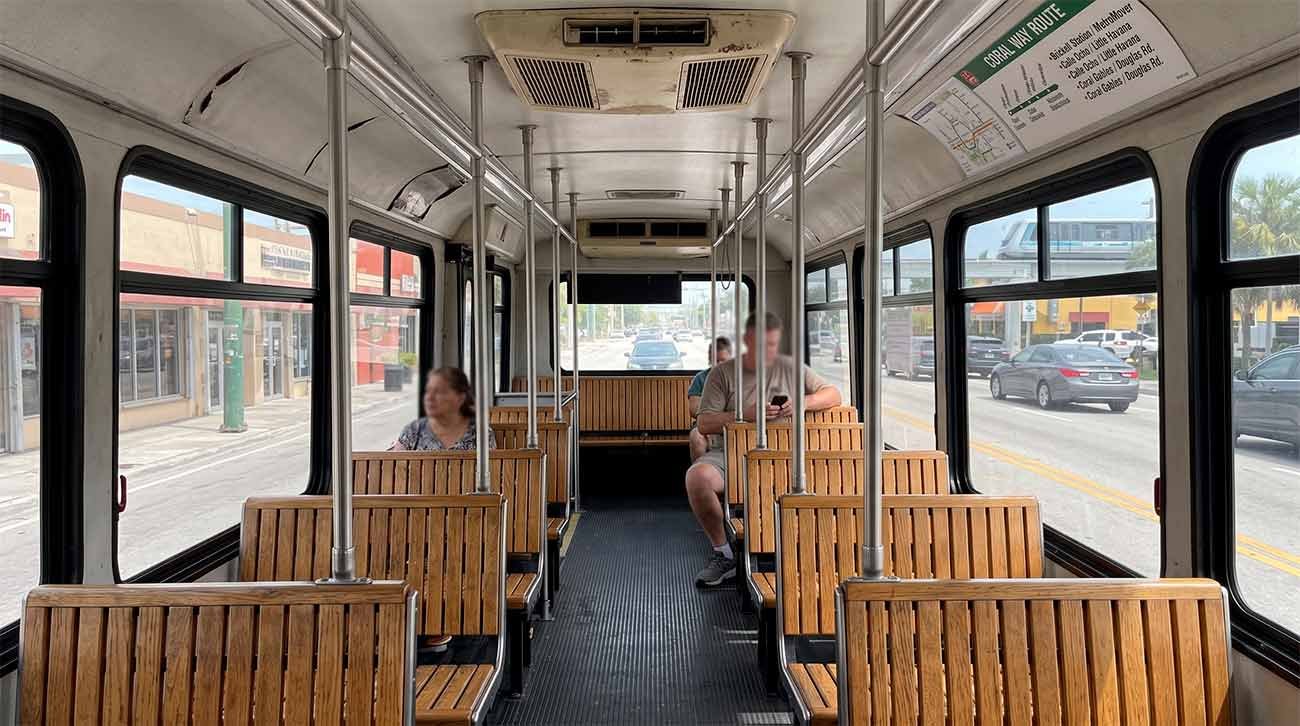
The interior of a municipal trolley features unpadded wooden slats. After 20 minutes, the lack of suspension and rigid seating becomes noticeable. Additionally, the air conditioning units operate at full strength year-round. On a humid 90°F (32°C) summer afternoon, stepping inside feels freezing. Carry a light layer if you plan to ride an entire loop.
Real-World Traffic Delays
Official schedules advertise arrival frequencies of every 15 to 20 minutes. On gridlocked streets like Calle Ocho (SW 8th St) in Little Havana during evening rush hour (4:30 PM – 6:30 PM), or Collins Avenue in Mid-Beach, vehicle traffic halts the trolleys. A scheduled 15-minute wait can easily turn into 40 minutes under direct sunlight.
Sunday & Holiday Shutdowns
Not all trolley routes run seven days a week. Relying on a trolley without checking weekend schedules can leave you stranded in industrial corridors.
| Route Name | Operating Jurisdiction | Sunday Service Availability |
| Brickell Loop | City of Miami | Operating (7:00 AM – 8:00 PM) |
| Little Havana Route | City of Miami | Operating (7:00 AM – 8:00 PM) |
| Biscayne / Edgewater | City of Miami | Operating (7:00 AM – 8:00 PM) |
| Coconut Grove Route | City of Miami | Operating (7:00 AM – 8:00 PM) |
| Wynwood Route | City of Miami | NO SUNDAY SERVICE |
| Overtown Route | City of Miami | NO SUNDAY SERVICE |
| Stadium / Health District | City of Miami | NO SUNDAY SERVICE |
| South Beach Loop | City of Miami Beach | Operating (8:00 AM – 11:00 PM) |
| Middle Beach Loop | City of Miami Beach | Operating (8:00 AM – 11:00 PM) |
| North Beach Loop | City of Miami Beach | Operating (8:00 AM – 11:00 PM) |
If you head to Wynwood on a Sunday afternoon expecting a free trolley back to Downtown, you will be forced to walk or order a rideshare.
The “Park Once” Financial Strategy
Parking in Miami’s high-traffic neighborhoods is a major expense. Garages in South Beach, Wynwood, and Brickell routinely charge $8 to $12 per hour, or flat event rates of $30 to $50.
| Target Neighborhood | Average Garaged Parking Cost | “Park Once” Trolley Alternative | Real Savings |
| Wynwood Arts District | $30.00 / day (Surface Lots) | Park near Edgewater/Omni ($10/day), ride Wynwood Trolley in | $20.00 / day |
| South Beach (Lincoln Rd) | $35.00 / day (Valet / Private) | Park at 13th & Collins Municipal Garage ($20/day), use Beach Trolley | $15.00 / day |
| Brickell Financial Core | $45.00 / day (Hotel Valet) | Park at outskirts garage, ride Metromover & Brickell Trolley $0 | $35.00 / day |
| Little Havana (Calle Ocho) | $25.00 / day (Private Lots) | Park near Marlins Park garage ($10/non-game days), take Little Havana Trolley | $15.00 / day |
By choosing a centralized garage on the edge of a commercial zone, you pay a lower daily rate once and rely on the trolley loops to move between shops, restaurants, and sights within that neighborhood.
Neighborhood Breakdown & Route Utility Matrix
| Neighborhood | Route Name | Utility Rating | Primary Bottleneck / Risk |
| Brickell | Brickell Loop | High (Frequent) | SE 1st Ave gridlock during 5 PM rush hour |
| Little Havana | Little Havana / Coral Way | High (Essential) | SW 8th St (Calle Ocho) narrow single-lane traffic |
| Wynwood | Wynwood Route | Medium (No Sundays) | Complete lack of service on Sundays |
| South Beach | South Beach Loop | High (Continuous) | Washington Ave delivery truck blockages |
| Coral Gables | Ponce de Leon Route | Very High (Reliable) | Miracle Mile traffic during lunch hours |
Brickell & Downtown
The Brickell Trolley runs along Miami Avenue and Brickell Avenue. It is useful for traveling from Mary Brickell Village down to Financial Center residential towers. However, during rush hours, walking or taking the elevated Metromover is significantly faster than sitting in gridlocked traffic along SE 1st Avenue.
Little Havana
The Little Havana Trolley is one of the most practical routes in the system. It circles residential areas and delivers visitors directly along Calle Ocho (SW 8th Street) near Domino Park and the local cigar shops. On hot days, taking this route from the West Flagler corridor down to SW 8th Street spares you a long, unshaded walk under scorching sun.
Wynwood & Design District
The Wynwood Trolley connects the Arts District to the Design District and North Miami Avenue. It eliminates the need to pay for multiple parking spots between Wynwood Walls and luxury retail blocks on NW 39th Street. Remember: It does not operate on Sundays.
Miami Beach (South, Mid, North)
Miami Beach operates four overlapping trolley loops: South Beach Loop, Middle Beach Loop, North Beach Loop, and Collins Express. The South Beach Loop runs along Washington Avenue and Alton Road, making it an excellent alternative to walking in extreme humidity. It connects directly to Lincoln Road Mall, South Pointe Park, and the Miami Beach Convention Center.
Coral Gables & Coconut Grove
The Coral Gables Trolley (running along Ponce de Leon Boulevard) is managed by the City of Coral Gables, operating Monday through Saturday. It provides a smooth, reliable connection between the Douglas Road Metrorail Station and the Miracle Mile shopping district. Combined with the Coconut Grove Trolley, it forms an efficient way to visit historic suburbs without handling a car.
The PortMiami Cruise Hack
The Coral Way Trolley route includes service stops near PortMiami. If you are staying in Downtown Miami or near Brickell before a cruise, you can board the Coral Way trolley heading toward the port. Crucial detail: You must inform the driver when you board that you are heading to the cruise terminals so they complete the loop into the port access areas.
Boarding Rules: Luggage, Strollers, and Tracking Apps
To keep vehicles moving, drivers strictly enforce basic transit rules:
- Luggage: Large checked suitcases (28 inches and larger) are problematic. Trolleys lack dedicated luggage racks or under-bus storage compartments. If you board with massive rolling bags during peak hours, you will block narrow aisles, face limited standing room, and potentially be denied entry by the driver if the vehicle is full. Limit trolley trips to backpacks, totes, or small carry-ons.
- Strollers: Children’s strollers must be folded completely before stepping onto the boarding steps. You cannot roll an open stroller onto the trolley aisle.
- Bicycles: Every municipal trolley features a rack mounted on the front bumper capable of holding two standard bicycles. It operates on a first-come, first-served basis.
- Real-Time Tracking Apps: Do not rely on outdated third-party tracking apps like the discontinued TSO Mobile app.
- For mainland Miami: Use the City of Miami Trolley Tracker web app or the Transit App.
- For Miami Beach: Download the official City of Miami Beach e-Gov app or check the official city transit portal.
Two Travel Scenarios: The Tourist Trap vs. The Smart Move
| Factor | Scenario A: The Tourist Trap | Scenario B: The Smart Move |
| Route Strategy | Private Commercial Tour Bus + Valet Parking | Metromover + City Trolley + $2.25 Express Bus |
| Transport Cost | $165.00 (3 Passes @ $55) + $45 Parking | $4.50 Total ($2.25 x 2 express bus tickets) |
| Flexibility | Rigid hop-on points, long waits at crowded stops | Dynamic transfers between elevated train and local trolley |
| Bay Crossing | Stuck in open-deck bus traffic across causeway | Rapid Metrobus 120 express lane connection |
| Total Out-of-Pocket | $210.00 spent in one day | $4.50 spent in one day |
Scenario A: The Tourist Trap
A family of three staying in Brickell wants to visit Wynwood and South Beach. They buy three commercial sightseeing passes for $165 total. They wait 45 minutes at a designated stop, ride across the causeway stuck in open-air heat, get dropped off blocks away from their actual destination, and pay $45 for hotel valet when they give up and rent a car the next day.
Scenario B: The Smart Move
A pair of travelers staying in Brickell takes the Metromover (Free) to School Board Station, hops on the Biscayne Trolley (Free) directly into Wynwood, visits the murals, and walks to the Biscayne Boulevard bus stop. They take the Metrobus Route 120 ($2.25 each) across the causeway straight into South Beach, then use the Miami Beach South Beach Loop Trolley (Free) to travel down to South Pointe Park.
How to Ride the Miami Trolley Without Wasting Your Day
- Locate an official stop: Look for rectangular metal signs marked with the trolley logo (Green/Orange on the mainland, Blue/Green on the Beach). Trolleys will not stop if you wave at them from a non-designated street corner.
- Verify the vehicle destination display: Read the digital sign above the front windshield to confirm the route direction (e.g., “Brickell Loop – Northbound”).
- Board through the front door: Step up, take a seat on the wooden benches, or hold onto the overhead handrails if standing room only.
- Request your stop: Pull the overhead yellow cord or press the stop-request button one block before your desired destination.
- Exit through the rear door: Step off smoothly to allow incoming passengers to enter through the front.
Frequently Asked Questions
Is the Miami Trolley completely free?
Yes. Both the City of Miami Trolley and Miami Beach Trolley are 100% free municipal transit services funded by local tax dollars. You do not need a ticket, card, app, or registration to board.
Does the free trolley go from Miami to Miami Beach?
No. The City of Miami Trolley operates exclusively on the mainland, while the Miami Beach Trolley operates exclusively on the island. To cross Biscayne Bay between the two systems, you must take a paid express bus ($2.25) or a rideshare service across the causeway.
What time does the Miami Trolley stop running?
Operating hours vary by route. Most major routes run from 6:30 AM to 11:00 PM Monday through Saturday. Sunday schedules are shortened (typically 8:00 AM to 8:00 PM), and several commercial routes (such as Wynwood) do not operate on Sundays at all.
Can I take my cruise luggage on the free trolley?
You can bring small carry-on bags or backpacks, but bringing large, full-sized suitcases onto crowded trolleys is discouraged and can be difficult due to narrow aisles and a lack of luggage storage racks.