
How to Use Public Transportation in Miami (Without Losing Hours)
Miami has public transportation.
But it’s not built for tourists.
It’s built for specific corridors of the city — and if you don’t understand that before arriving, you can easily lose hours moving between neighborhoods.
This is your practical Move Smart breakdown of how public transportation in Miami actually works.
No hype. No fantasy. Just logistics.
First: Understand the Geography Problem
Miami is not compact.
Downtown, Brickell and Coral Gables are connected reasonably well.
Miami Beach is separate.
Wynwood is separate.
Outlets and shopping areas are even farther.
Public transportation works when your base is central and your movements are linear.
It becomes slow when you’re jumping across zones.
That’s the core rule.
MetroMover: The Best Part of the System
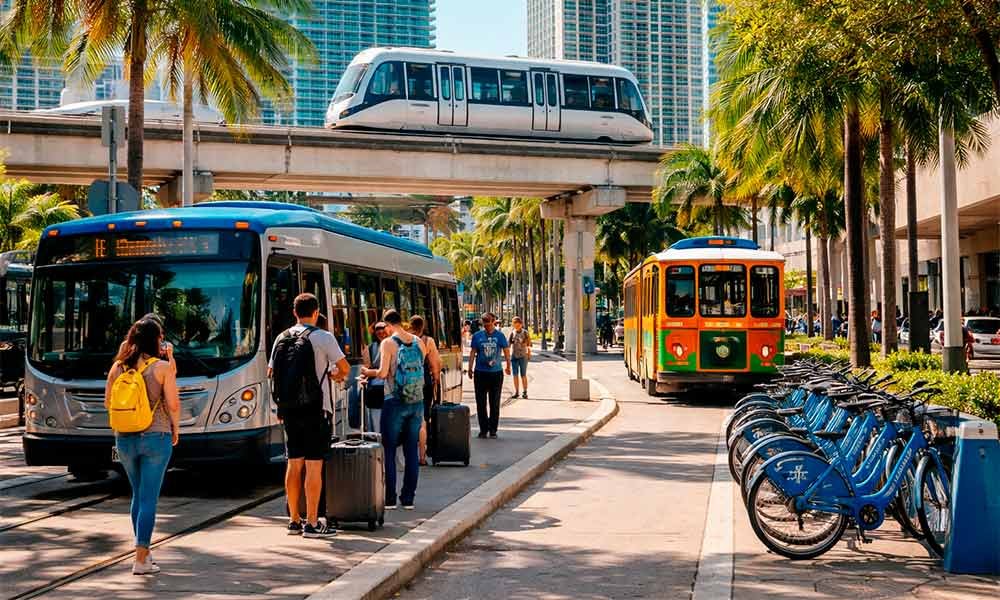
MetroMover is a small elevated train that runs only in Downtown and Brickell.
It is completely free.
No ticket required. No card required.
It runs frequently and connects:
- Brickell residential area
- Downtown business district
- Bayside area
- Government Center (connection to Metrorail)
If you are staying in Brickell or Downtown, this is the smartest transportation option in the city.
It’s fast, reliable and predictable.
Outside those zones, it doesn’t exist.
Metrorail: Useful, But Limited
Metrorail is Miami’s main rail line.
It connects:
- Miami International Airport
- Downtown
- Brickell
- Coral Gables
- Dadeland
This makes it useful for:
Airport → Brickell
Airport → Downtown
Airport → Coral Gables
It does not go to:
- Miami Beach
- Wynwood
- Design District
- Major outlets
That surprises many visitors.
The rail coverage looks good on paper, but geographically it covers only a slice of the city.
How Payment Works: EASY Card & EASY Ticket
For Metrorail and buses, Miami uses the EASY system.
There are two options:
EASY Card
A reloadable plastic card.
Best for:
- Multiple rides
- Day passes
- Transfers
- Stays longer than a couple of days
EASY Ticket
A paper magnetic ticket.
Best for:
- One-time use
- Short visits
Important detail: paper tickets can demagnetize. It’s not rare.
If you plan to move around more than once, the EASY Card is more practical.
MetroMover does not require either because it’s free.
Paying the Bus Driver: Cash Is Possible (But Not Smart)
You can pay cash on Miami buses.
However:
- You must pay exact fare
- No change is given
- Transfers are less seamless
- It slows boarding
If you are planning to use buses more than once, paying in cash quickly becomes inconvenient.
From a Move Smart perspective, relying on exact change during a short trip adds unnecessary friction.
Miami Buses: Functional, But Slow
Buses are the only way to connect many neighborhoods.
But they depend entirely on traffic.
And Miami traffic can be unpredictable — especially during rush hour or event weekends.
Buses work best when:
- You’re not in a rush
- You’re staying in South Beach
- You’re connecting short distances
They become inefficient when:
- You have tight reservations
- You’re crossing multiple zones
- Your trip is only 3–4 days long
The system works. It just moves slowly outside rail areas.
Free Trolleys: A Hidden Option
Certain neighborhoods operate free trolley systems.
You’ll find them in:
- Miami Beach
- Coral Gables
- Downtown
They are free and useful for short local loops.
They are not a citywide solution — but within specific neighborhoods, they can replace buses effectively.
Bikes and Scooters: Sometimes Faster Than Transit
In compact areas like:
- Brickell
- South Beach
Bikes and electric scooters can be faster than waiting for a bus.
For distances under 15 minutes, they are often more efficient.
They are not suitable for crossing the entire city.
But for local mobility, they’re underrated.
What a Realistic Travel Day Looks Like
Let’s say you plan this route:
Airport → Brickell → Wynwood → Miami Beach
Using public transportation only:
- Metrorail from Airport to Brickell
- Bus from Brickell to Wynwood
- Another bus to Miami Beach
Depending on timing, traffic and connections, this can take 1.5 to 2 hours.
It’s doable.
But it’s not frictionless.
If your hotel is central and your movements are limited, public transport works.
If you’re bouncing across neighborhoods daily, time becomes the real cost.
Who Public Transportation Works For
It works well if you:
- Stay in Downtown or Brickell
- Have a flexible schedule
- Are staying longer than 4–5 days
- Don’t mind slower transitions
It’s less ideal if you:
- Have a short 3-day trip
- Plan heavy shopping days
- Want total flexibility
- Are staying in Miami Beach but exploring mainland daily
Final Perspective: Move Smart Means Choosing When to Use It
Public transportation in Miami isn’t bad.
It’s just limited.
Used strategically — especially in central zones — it can save money and simplify your trip.
Used blindly across a spread-out itinerary, it can quietly consume half your day.
Understanding the geography is more important than understanding the system.
That’s what moving smart in Miami really means.