
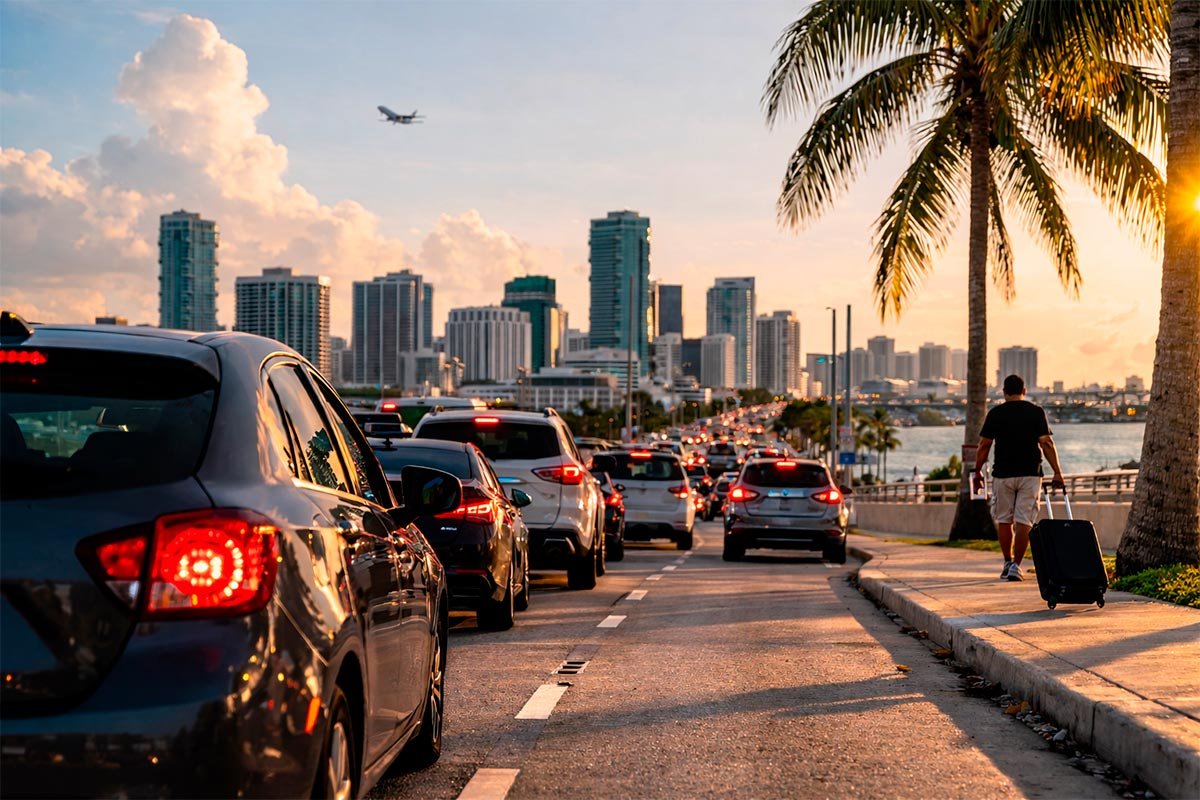
Best Time to Drive in Miami (Avoid Traffic & Rush Hour)
If you are planning a Miami trip, this is not a small detail. Traffic here does not just make driving unpleasant. It can throw off your beach day, delay lunch plans, make a short ride feel absurd, complicate Uber pickups, and turn an airport run into a stressful mess.
The real question is not only when Miami traffic is lighter. It is how to organize your day so traffic does not quietly ruin it.
Quick answer: when driving in Miami is usually easier
Late morning into early afternoon is usually the least frustrating window for most regular city driving. Early commuter hours are already busy, and late afternoon into early evening is usually worse.
TomTom’s Miami data shows that a 10 km drive took about 19 minutes 56 seconds during morning rush hour, but 23 minutes 43 seconds during evening rush hour, with heavier congestion and lower average speeds later in the day.
That does not mean late morning is “easy.” It means it is often the closest thing Miami gives you to manageable.
In Miami, the best time to drive is usually not the earliest possible time. It is the time that protects the rest of your day from unnecessary delays.
If you have flexibility, this is the practical rule: avoid building important cross-city drives around late afternoon whenever possible. That is when the city tends to feel most draining on the road.
Miami Traffic Mental Map (Simple Guide)
If you prefer a quick mental map instead of reading everything, this table shows how traffic patterns usually behave across a normal weekday in Miami.
Time Window What Usually Happens Driving Experience 6:00 – 7:00 AM Early commuters begin moving Roads still manageable 7:00 – 9:00 AM Morning rush hour peaks Heavy traffic across main highways 9:30 – 10:30 AM Rush hour fades but traffic still busy Improving but not ideal 10:30 AM – 2:30 PM Calmest part of the day Best time to drive across the city 2:30 – 4:00 PM Traffic slowly builds again Still manageable 4:30 – 7:00 PM Evening rush hour Worst time to drive in Miami 7:30 – 9:00 PM Traffic begins to clear Driving becomes easier After 9:00 PM Roads finally relax Usually smooth driving This pattern is not perfect every day, but in most cases it reflects how Miami traffic behaves across weekdays.
Why Miami traffic ruins more than just the drive
A lot of travelers think of traffic as an inconvenience. In Miami, it is more than that. It changes what your day can realistically hold.
A plan that looks efficient on a map can stop making sense in real life once you add congestion, parking, traffic lights, lane changes, causeways, pickups, and general slowdown around busy areas. This is why people often overestimate how much they can do in one day.
That matters even more if your day includes fixed times. A brunch reservation, cruise check-in, airport drop-off, outlet run, or paid activity feels very different when one delay starts pushing everything else.
This is also why “it looked close on the map” is one of the most common Miami planning mistakes.
The map mistake: when a short route is not a quick route
Miami has many drives that look harmless in distance but are annoying in practice.
A short route can still be slow because the problem is not just miles. It is timing, direction, and what part of the city you are crossing. A route that looks simple between neighborhoods can become much more tiring if you are doing it during the wrong window.
TomTom’s data supports that basic reality. Miami’s average congestion level in 2025 was 46.8%, and average speeds dropped sharply during rush windows, especially in the evening.
So if your plan depends on stacking several “short” rides together, be careful. In Miami, short does not always mean quick, and quick does not always mean reliable.
Best times to leave for sightseeing and regular day plans
For most sightseeing days, the easiest approach is not to start everything as early as possible. It is to avoid forcing big moves during the worst traffic windows.
Late morning often works better for city movement than people expect. By then, the earlier commute pressure has eased a bit, but you are still ahead of the heavier late-day buildup.
This works especially well if your plan looks like this:
- leave the hotel after breakfast
- do one main area well
- add one or two nearby stops
- avoid bouncing across the city for no reason
That last part matters. A realistic Miami day is usually better than an ambitious Miami day.
Good planning in Miami is less about squeezing more into the schedule and more about avoiding bad timing that makes everything feel harder than it should.
If you already know your day will involve Miami Beach, Downtown, Brickell, Wynwood, the airport area, or shopping zones, try to group stops by area instead of treating the whole city like one compact grid. Miami is not that kind of city.
The worst time to cross the city
Late afternoon into early evening is usually the hardest window for a longer drive. TomTom’s 2025 numbers show evening rush hour was worse than morning rush hour in Miami, with slower average speeds and higher congestion.
This is the part of the day when a drive that seemed reasonable earlier can start feeling like a bad decision.
That does not mean you should never drive then. It means you should be more selective about what kind of drive you are agreeing to. A short local move may still be worth it. A cross-city repositioning just because “it is only one more stop” often is not.
This is also when the emotional cost goes up. Even if you eventually get there, your energy, patience, and timing are already worse by the time you arrive.
When airport drives need a bigger buffer than you expect
This is where people make expensive mistakes.
The airport run is one of the clearest examples of why traffic in Miami is not just annoying. It can affect the part of your trip where timing matters most. Miami International Airport says arrival timing varies by airline and day, but TSA encourages passengers to arrive at least two hours before domestic flights and three hours before international flights. MIA also reminds travelers to leave enough time for parking or transit, baggage, and security.
That is airport time. It does not include the risk of your road timing being too optimistic.
So if you are heading to MIA, do not plan backward from the airport recommendation alone. Add road uncertainty too, especially if you are leaving during a busy part of the day.
A Miami airport run should never be built on the most optimistic version of the drive.
If your flight matters, and of course it does, this is not the moment to trust a pretty ETA on the map.
Why getting an Uber can also feel worse at the wrong time
Even if you are not driving yourself, traffic still affects you.
At bad hours, Uber does not remove congestion. It only removes the part where you are the one holding the steering wheel. That can still be worth it, especially if you want to avoid parking stress, rental car hassle, or mentally exhausting city driving.
But the timing problem remains. Pickup may take longer. Busy roads still stay busy. A short ride can still become slower than expected.
That is why the smartest strategy is often not “car versus Uber.” It is choosing the right tool for the wrong hour.
Sometimes the better move is:
- Uber for one difficult leg
- walking more within one area
- avoiding unnecessary hotel-to-hotel bouncing
- using rail for part of the route when it actually helps
If you do not want to drive at the worst times, change the plan — not just the hour
This is where the post becomes more useful than a simple traffic guide.
Sometimes the smartest fix is not leaving 15 minutes earlier. It is changing the structure of the day.
If you know a route overlaps with one of Miami’s more frustrating traffic windows, you may be better off doing one of these instead:
- stay longer in the area you are already in
- move a cross-city trip earlier or later
- use Uber for one segment instead of driving the whole day
- use Metrorail or Metromover when the route makes sense
Miami-Dade Transit’s official system includes Metrorail, Metromover, and trip-planning tools. Metrorail fares are $2.25, and Miami-Dade says Metromover is always free.
That does not make public transit a universal answer for Miami. It is not. But in the right corridor, it can be smarter than forcing a frustrating drive just because you already rented a car.
Is Miami a Car-Dependent City?
Does the time of year make Miami easier to drive?
A little, but not dramatically.
If you avoid the busiest holiday periods, major school-break windows, and the Atlantic hurricane season, Miami can feel slightly more manageable. The key word is slightly. The National Hurricane Center says the Atlantic hurricane season runs from June 1 through November 30.
Still, Miami is not the kind of destination that suddenly becomes empty. Official Greater Miami tourism materials continue to describe strong travel demand and a global visitor base, which helps explain why truly quiet periods are hard to count on.
So yes, some periods may feel a bit lighter than others. But in practical terms, your daily timing matters more than chasing the idea of a magically calm season.
Best days of the week to drive in Miami
There is no perfect answer that works every week, but regular weekdays usually require more timing discipline than travelers expect, especially when your plan depends on crossing the city during commuter windows. TomTom’s data is clear that Miami rush hour is a real planning factor, not a small annoyance.
In practical trip terms, the better question is not “What is the perfect day?” It is “Do I really need to make this move today, at this hour, through this part of the city?”
That question saves more time than guessing a magical day of the week.
Final verdict
The best time to drive in Miami is usually late morning to early afternoon, when the city often feels more manageable than during commuter peaks. The worst time is usually late afternoon into early evening, especially for longer or cross-city drives.
But the bigger lesson is this: Miami traffic is a planning problem more than a driving problem.
If you want a better trip, do not only ask when to drive. Ask:
- do I need to make this drive at all?
- can I group stops better?
- should I stay in one area longer?
- would Uber, Metrorail, or a different route protect the day better?
- am I planning this airport run with enough margin, or just enough optimism?
That is the real difference between a manageable Miami trip and one that keeps wasting your time in transit.
The best time to drive in Miami is the time that protects the rest of your day.