
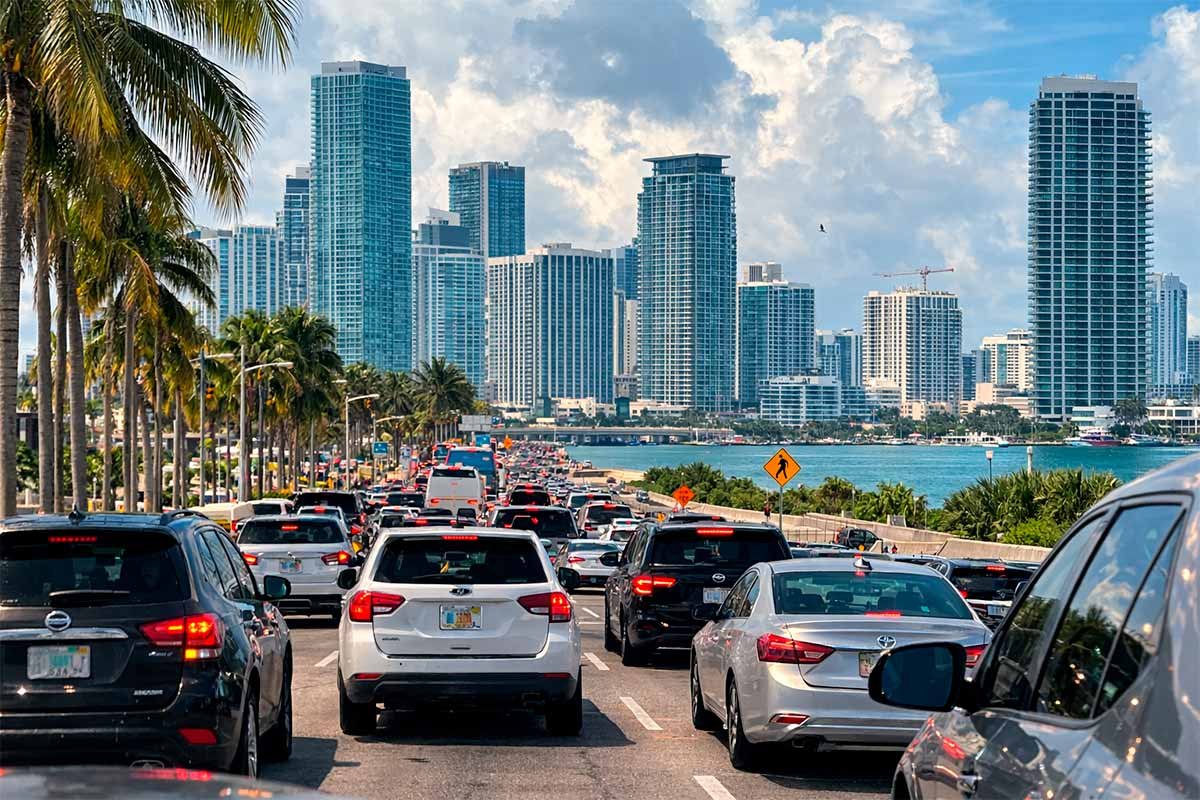
Why Miami Traffic Feels So Chaotic (Even on Short Drives)
Quick answer: Miami traffic feels chaotic because the city concentrates large numbers of cars into a small number of bridges, highways, and corridors. Tourism, airport traffic, rideshare vehicles, and daily commuters all rely on the same routes, which creates bottlenecks that make even short drives take longer than expected.
Driving in Miami often surprises first-time visitors. Even frequent visitors underestimate it the first time they try to cross the city during rush hour.
One thing many visitors notice quickly is that a drive that looks simple on the map suddenly feels slow once you’re actually inside the traffic flow.
For example, a short trip from Brickell to South Beach — something that looks trivial on Google Maps — can easily stretch to half an hour depending on the time of day and which causeway you hit.
On the map, everything looks close. Miami Beach, Downtown, Brickell, Wynwood and the airport seem only a few miles apart.
But once you’re actually on the road, those short distances can turn into unexpectedly long drives.
A route of just 5 miles (about 8 km) can sometimes take 30–45 minutes, especially during busy hours.
According to INRIX traffic reports, Miami regularly ranks among the most congested metropolitan areas in the United States during peak commuting periods.
This doesn’t happen because Miami is uniquely “bad” at traffic. It happens because of how the city is built, how people move through it, and how tourism interacts with the local road system.
Understanding this before you plan your daily routes can save time, frustration, and sometimes money during your trip.
Why Miami Traffic Feels Worse Than It Looks on the Map
Several factors combine to make Miami traffic feel worse than expected:
- limited bridges connecting Miami Beach and the mainland
- heavy airport and tourism traffic
- major highways carrying regional commuters
- frequent rideshare pickups in busy districts
This is one of the main reasons many visitors ask why Miami traffic feels so bad even for short distances. Many travelers underestimate how long it takes to move around Miami.
The reason is simple: distance and travel time are not the same thing here.
A drive from Brickell to South Beach may be only 4–6 miles (6–10 km) depending on the route. On paper, that sounds like a quick trip.
But in reality, that drive may involve:
- crossing a causeway
- waiting through several traffic lights
- sharing lanes with rideshare pickups
- navigating busy urban intersections
Individually these delays seem small. Together, they are exactly what makes a short Miami drive feel much longer than expected.
In Miami, a short distance rarely means a quick drive.
That’s one of the most common surprises for visitors who expect the city to function like a compact downtown area.
Miami Is More Spread Out Than Tourists Expect
Miami looks compact on travel maps, but it actually functions as a spread-out metropolitan area.
Major zones of interest for visitors are separated from each other:
- Miami Beach
- Downtown
- Brickell
- Wynwood
- Design District
- Miami International Airport
Moving between these areas often means using the same few main roads or bridges.
Because so many people rely on those same routes, traffic pressure builds quickly.
This is especially noticeable during:
- morning and evening commuting hours
- weekend beach traffic
- large events
- busy tourism seasons
Bridges and Causeways Create Natural Bottlenecks
Locals quickly learn that the causeways behave almost like funnels. When traffic builds up on one side — especially during beach hours or event nights — the backup often stretches far beyond the bridge itself.
One of the biggest reasons Miami traffic feels chaotic is geography.
The city is divided by Biscayne Bay, which separates Miami Beach from the mainland.
To move between them, drivers depend on a small number of causeways:
- MacArthur Causeway
- Julia Tuttle Causeway
- Venetian Causeway
These bridges act as choke points.
If traffic builds up on one of them, the delay spreads quickly to nearby areas.
When thousands of cars depend on just a few crossings, even small slowdowns can ripple across the entire route.
For visitors staying in Miami Beach but planning activities on the mainland, this is one of the main reasons driving times often feel longer than expected.
Major Highways Concentrate Regional Traffic
Miami also depends heavily on a few major highways.
One of the most important is Interstate 95 (I-95), which runs through the city and connects it to the wider South Florida region.
This highway carries:
- commuters from surrounding areas
- airport traffic
- freight and logistics vehicles
- visitors traveling between neighborhoods
Because so much traffic depends on this corridor, congestion can quickly affect nearby routes.
Large interchange areas — especially where several highways connect — can become slow even outside traditional rush hours.
Construction Projects Add Another Layer of Delay
Like many fast-growing cities, Miami constantly has infrastructure projects underway.
One of the most visible examples is the I-395 / SR-836 / I-95 Design-Build Project, which includes the construction of the new Signature Bridge near Downtown.
The project, expected to continue for several years, aims to improve long-term traffic flow and redesign one of the region’s most complex interchanges.
According to the Florida Department of Transportation (FDOT), the project will modernize key highway connections and improve traffic distribution in the area.
According to the Florida Department of Transportation (FDOT), the project is designed to improve long-term regional mobility and modernize one of Miami’s most complex highway interchanges.
But during construction, drivers may encounter:
- temporary lane changes
- shifting traffic patterns
- occasional nighttime closures
For visitors unfamiliar with the road network, these changes can make navigation feel confusing.
Airport Traffic Affects More of the City Than You Think
Even if you are not flying, Miami International Airport (MIA) influences traffic across several nearby routes.
MIA is one of the busiest international airports in the United States.
In recent years it has handled more than 50 million passengers annually, according to airport statistics.
That means a constant flow of:
- rental cars
- rideshare drivers
- hotel shuttles
- taxis
- private pickups
Many of those vehicles are heading directly toward the same downtown corridors visitors use — which means airport traffic often blends with regular city traffic rather than staying isolated near the terminals.
All of this traffic converges around the airport and spreads into nearby highways.
Visitors often notice that routes connecting the airport with Downtown or Miami Beach can feel especially busy.
If you’re planning airport transfers, it’s worth allowing extra time.
You can read more about that in our guide: How Early to Arrive at Miami Airport (MIA).
Rideshare and Delivery Traffic Adds Small but Constant Disruptions
Another factor many visitors don’t expect is the sheer number of rideshare vehicles.
Miami has a large presence of:
- Uber
- Lyft
- food delivery drivers
In busy neighborhoods such as:
- South Beach
- Brickell
- Wynwood
rideshare drivers frequently stop briefly to pick up or drop off passengers.
Even short stops in active lanes can slow traffic.
It’s not unusual to see a car pause for a quick pickup and momentarily block a lane.
These small interruptions happen constantly throughout the day and gradually affect the flow of traffic in dense areas.
Is Miami Traffic Always This Bad?
Not necessarily.
Traffic conditions vary widely depending on:
- time of day
- day of the week
- specific neighborhood
- tourism season
Many routes are relatively manageable during:
- late mornings
- early afternoons
- weekday mid-day hours
But congestion tends to increase during:
- morning commute hours
- late afternoon and evening
- weekends near Miami Beach
- major events or holidays
Simply shifting a drive by 30 minutes can sometimes turn a stressful trip into a smooth one.
Understanding traffic patterns is one of the most important parts of moving around the city efficiently — which is why transportation decisions are a central topic in our Move Smart in Miami guides.
When Miami Traffic Usually Feels Worst
Visitors are most likely to experience heavy traffic in these situations:
- Morning commute: roughly 7–9 AM
- Evening commute: roughly 4–7 PM
- Routes to Miami Beach during weekends
- Airport corridors during peak travel times
- Popular districts during nightlife hours
Even a small adjustment in schedule — leaving 30 minutes earlier, for example — can sometimes avoid the worst congestion.
Visitors sometimes assume the problem is simply “bad traffic.” In reality, Miami traffic is mostly predictable once you understand where the pressure points are.
What Visitors Can Do to Avoid the Worst Traffic
You don’t need to avoid driving in Miami entirely, but planning helps.
A few practical tips:
Allow extra time for short drives
If the map shows 20 minutes, consider giving yourself 30–35 minutes during busy periods.
Avoid crossing the bay multiple times in one day
Switching repeatedly between Miami Beach and the mainland can increase travel time.
Group activities by area
Plan one day around Miami Beach, another around Downtown or Wynwood.
Be cautious with tight schedules
Dinner reservations, tours, or airport transfers should include a buffer.
Choose accommodation strategically
Where you stay can have a major impact on how much driving you need.
For some travelers, staying closer to key activities can reduce both transportation time and transportation costs.
In simple terms, Miami traffic feels chaotic because too many vehicles depend on the same bridges and highways at the same times. Geography, tourism, and daily commuting patterns combine to create congestion even on relatively short routes.
The Real Lesson About Miami Traffic
Miami isn’t impossible to drive.
But it is a city where travel time is less predictable than the map suggests.
Bridges, airport traffic, tourism, and urban congestion all interact in ways that can slow even short trips.
Once you understand this, planning becomes much easier.
The biggest mistake visitors make is assuming distance equals time.
Once you understand how Miami traffic actually behaves, the city becomes much easier to navigate. The key is not distance — it’s timing and geography.