
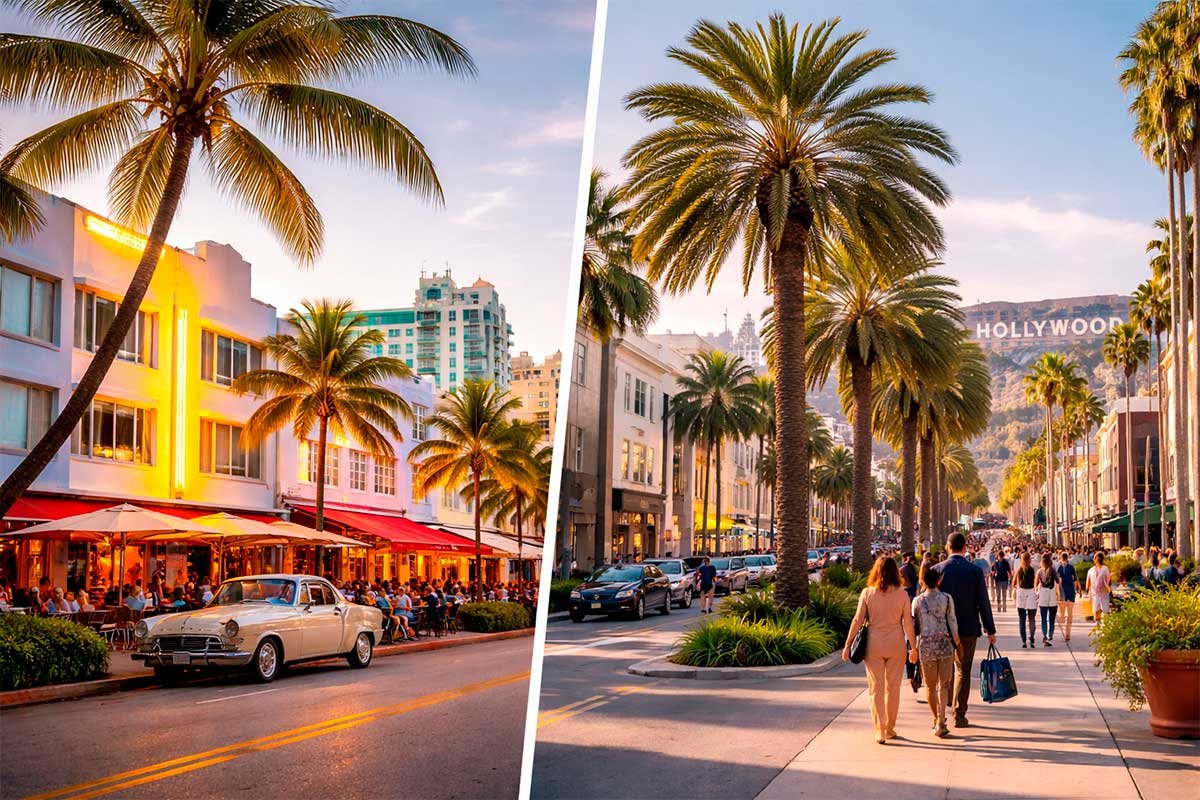
Miami or Los Angeles: Better Shopping, More Luxury, Better Beach Vibe?
If your trip fantasy includes palm trees, luxury stores, good weather, and the feeling that you are somewhere iconic, Miami and Los Angeles can seem like natural competitors.
From far away, they almost belong to the same category. Both sell sun. Both sell image. Both suggest status, beauty, and the possibility of spending money in places that feel larger than daily life.
But from a Spend Smart perspective, they are not interchangeable.
The real question is not which city looks more glamorous online. The real question is simple: is Miami or Los Angeles better for shopping, atmosphere, and overall trip value?
Quick answer
For most travelers deciding between Miami and Los Angeles, Miami is usually the easier city to enjoy well.
If your priority is shopping, warm-weather energy, beach atmosphere, and a trip that feels rewarding quickly, Miami tends to deliver more practical value.
If your priority is Hollywood symbolism, Beverly Hills, celebrity culture, and a more cinematic kind of prestige, Los Angeles may feel more compelling — but also more spread out, less immediate, and easier to overspend on.
A glamorous city is not automatically the city that gives you the better trip.
That is the core difference.
Why Miami and Los Angeles feel comparable at first
There is a reason people connect these two cities in their heads.
Both carry a polished American dream version of travel. They suggest sunshine, attractive neighborhoods, expensive storefronts, and the possibility that your trip could feel a little more cinematic than usual.
Los Angeles adds an even heavier symbolic layer. Hollywood, Beverly Hills, movie mythology, Rodeo Drive, celebrity culture, and the idea that fame itself is part of the landscape all push LA deeper into the realm of fantasy.
Miami has its own magnetism. It does not need cinema history to feel desirable. It has heat, beach energy, a strong Latin presence, visible consumption, and a more vacation-ready atmosphere. The glamour often feels less distant.
That matters because desire affects spending. People do not only spend on hotels, meals, and shopping bags. They also spend trying to buy a feeling.
The kind of luxury Miami tends to offer
Miami often feels easier to “read” as a traveler.
Its luxury is visible. You can feel it in the shopping districts, beachfront hotels, restaurant zones, branded spaces, cars, and the general vacation mood. Even if you are not paying top-tier luxury prices, you still experience part of that visual world.
That is one reason Miami works well for travelers who want a trip that feels elevated without becoming a full luxury-budget trip.
Luxury in Miami is often mixed with movement and leisure:
- shopping during the day
- beach nearby
- warm weather built into the experience
- neighborhoods with distinct energy
- a stronger sense that spending and vacation are happening in the same emotional register
The Miami Design District, for example, presents itself as a creative neighborhood centered on fashion, design, art, and dining, with a large concentration of luxury brands. Sawgrass Mills, by contrast, is positioned as a major South Florida outlet destination with hundreds of stores and a notable luxury-outlet component.
That mix is important. Miami gives you both aspirational shopping and practical shopping logic within the same broader trip ecosystem.
The kind of luxury Los Angeles seems to offer
Los Angeles appears to sell a different version of prestige.
Its luxury is more symbolic. It comes attached to names, myths, and locations people already know before they arrive. Rodeo Drive is the clearest example: officially promoted as an iconic luxury shopping street in Beverly Hills, lined with major fashion houses and strongly tied to the city’s image of high-end glamour.
For travelers who want a broader retail experience, areas like The Grove and Beverly Center make more practical sense than treating Rodeo Drive as the whole Los Angeles shopping story.
That is powerful. But it is also where travelers need to be careful.
A place can be iconic without being especially useful for your trip budget. A famous shopping street can be worth seeing and still not be where your money works best.
This is where LA becomes more complicated from a Spend Smart angle. The fantasy may be stronger. The symbolism may be heavier. The “I’m really here” feeling may be intense. But practical value is not always proportional to symbolic value.
Iconic shopping and useful shopping are not the same thing.
That is not criticism. It is a framing tool.
If what you want is to stand near one of the world’s most famous luxury retail corridors and feel that myth up close, Los Angeles has an edge. If what you want is to integrate shopping into a rewarding tourist trip without everything depending on prestige and symbolism, Miami often feels more efficient.
Miami vs Los Angeles for shopping and trip value
This comparison becomes clearer when you separate shopping into three categories.
1. Aspirational shopping
This is shopping you partly consume with your eyes.
You may buy something, but the bigger purchase is the atmosphere: luxury storefronts, polished streets, high-end branding, and the satisfaction of being in a place associated with wealth and status.
Los Angeles is very strong here because Rodeo Drive and Beverly Hills carry global symbolic weight.
Miami can absolutely do aspirational shopping too, especially in places like the Design District, which frames itself around fashion, art, and architecture as much as retail. But Miami’s version often feels less like a museum of status and more like part of an active, warm-weather trip.
2. Real shopping
This is where the city stops being just a visual fantasy and starts answering practical tourist questions.
Can you actually buy useful things across price tiers? Can shopping fit naturally into the trip instead of dominating the day? Can you shop well without turning the whole experience into a prestige exercise?
Miami is often stronger here, especially for travelers who care about outlets, mall logic, easy brand comparison, and combining shopping with other classic South Florida trip elements. Sawgrass Mills markets itself exactly around that large-scale outlet advantage.
3. Trip-friendly shopping
This is the most underrated category.
A city can have good stores and still be annoying to shop in. A city can have iconic shopping and still make the overall day feel scattered, tiring, or too dependent on logistics.
Miami has a natural advantage because shopping often feels connected to the broader trip identity: warm weather, beach mood, visible leisure, and a city rhythm that can make spending feel like one part of a larger experience.
Los Angeles may absolutely reward the right traveler, but the shopping appeal there often competes more directly with the city’s scale, symbolism, and spread-out nature. That can be exciting. It can also be inefficient.
Beach vibe is not a minor detail
People sometimes treat beach atmosphere as decoration. It is not.
It changes the emotional return of the trip.
Miami’s beach logic is simple and powerful: if you want shopping, heat, palm trees, and a city that still feels like vacation even when you are spending, Miami delivers a more coherent package.
That coherence matters financially. When the city’s climate, mood, and shopping energy all pull in the same direction, your trip usually feels satisfying faster. You need fewer “special” moments to justify the budget.
Los Angeles may still be more appealing if your dream is less about beach immediacy and more about cinematic California symbolism. But that is a different desire.
Miami often feels easier to enjoy on a short trip.
Los Angeles often asks more from the traveler before the city starts feeling rewarding.
What about celebrities, fame, and that Hollywood pull?
This is where Los Angeles becomes especially tempting.
The Hollywood sign, celebrity mythology, Beverly Hills, and the possibility of brushing against the entertainment machine all create a different level of curiosity. Even people who are not obsessed with celebrity culture still understand the symbolic charge of being near it.
But this is exactly where tourists can confuse cultural fantasy with travel value.
Yes, LA may feel more directly attached to cinema, fame, and public myth. That is real. But celebrities and high-status visibility are not exclusive to Los Angeles. Miami also belongs to the broader luxury-and-fame circuit in American travel culture.
The smarter question is not, “Which city has more glamorous people attached to it?”
It is:
Which city gives me more of the trip I can actually enjoy, instead of just admire from the outside?
That answer will differ by traveler.
Who will usually get more value from Miami
Miami is usually the better fit if you want:
- warm weather to matter every day
- shopping to feel built into the trip
- visible luxury without needing the most exclusive budget
- beach energy, Latin atmosphere, and strong vacation mood
- a city that feels rewarding even on a shorter trip
- more direct overlap between spending and enjoyment
Miami often turns fantasy into usable experience faster.
Who may still prefer Los Angeles
Los Angeles may still be the better choice if you want:
- stronger Hollywood mythology
- Beverly Hills and Rodeo Drive symbolism
- a more cinematic and culturally loaded form of luxury
- the curiosity of comparing myth with reality
- a city that feels less tropical and more iconic in an entertainment-industry sense
- a trip where observation matters as much as convenience
That does not make LA worse. It makes LA more specific.
The smartest way to think about this comparison
Do not compare Miami and Los Angeles as if they are mirror images.
They are better understood as two cities that sell overlapping dreams through different systems.
Miami often sells a dream you can step into quickly: heat, shopping, beach, visual pleasure, and vacation logic that makes sense fast.
Los Angeles often sells a dream you want to investigate: cinema, celebrity, prestige, symbolic neighborhoods, and a form of luxury that may be more powerful in the imagination than in your actual spending day.
Spend Smart starts where fantasy meets friction.
That is why many travelers will find Miami easier to enjoy well, even if Los Angeles remains deeply tempting.
Final takeaway
If your priority is a trip that blends shopping, warm weather, beach atmosphere, and fast emotional payoff, Miami is usually the safer choice.
If your priority is symbolism, celebrity mythology, iconic neighborhoods, and a more cinematic version of California, Los Angeles may have the stronger pull — but it often comes with more friction between fantasy and practical value.
That can still be worth it.
But it is not the same kind of value.
Miami is often easier to convert into a satisfying trip.
Los Angeles may offer a bigger myth.
Your smartest choice depends on whether you want your money to buy a more usable vacation — or a more cinematic one.